


A match needs a history
Fulfilled prophecy can support a claim of revelation when its wording credibly precedes the event, the event satisfies a sufficiently definite prediction, and the match is better explained by unusual foreknowledge than by ordinary alternatives. Each part needs evidence. An old text with a later interpretation, an accurate forecast and a demonstrated act of divine revelation are different conclusions.
This matters in comparing Islam and Christianity because a striking example can seem to grant authority to an entire religious system. A defender may move from Roman recovery to Muhammad’s prophethood, or from a pre-Christian Isaiah manuscript to the truth of every Christian claim. The missing steps are not repaired by making a list longer. We need to establish what each example contributes and then examine the wider account of God and salvation it is being used to support.
Five questions make the investigation manageable. What does the passage say in context? How do we know that wording existed before the proposed fulfillment? Which event would count as success or failure? How securely is that event known? What alternatives—ordinary prediction, broad wording, selective counting, intentional fulfillment or a report shaped by Scripture—could explain the correspondence? An ancient physical copy is especially useful for the second question, but contemporary quotation or well-evaluated transmission can also matter. Requiring an autograph for every historical claim would be an unreasonable standard.
The key is to avoid circularity. If the divine authority of a book is what we are trying to establish, we cannot use that authority alone to guarantee the date of its prediction and then use the prediction to prove the authority. Historical transmission can still be argued for; it must be argued for rather than smuggled into the starting point.
What Qur’an 30 actually commits itself to
In the standard reading of Qur’an 30:2–4, ghulibat al-rūm describes the Romans as defeated; sa-yaghlibūna says they will prevail after their defeat, within biḍʿ sinīn. Muslim commentators commonly understand this period as three to nine years. The passage continues with God’s command, the believers’ rejoicing and the certainty of God’s promise. Its theological meaning concerns God’s rule over events, not a detached military forecast.
Qur’an 30:2–4, selected text, editorial translation from Arabic: “The Romans have been defeated in the nearer land; after their defeat they will prevail within a few years.”
The Romans are normally identified as the eastern Roman Empire in its war with Sasanian Persia. This historical setting is plausible and widely discussed, but Persia is not named in the verses. Nor are the battle, ruler or starting year specified. The Arabic adnā al-arḍ is understood by al-Qurtubi through the sense nearer, with differing regional identifications. A claim that it uniquely identifies the earth’s lowest land near the Dead Sea adds geographical premises that the wording alone does not establish.
The strongest traditional argument deserves its full force. A public prediction, made during Roman adversity, with a limited deadline and an outcome beyond Muhammad’s military control would be more evidentially interesting than a vague hope. Al-Qurtubi treats the promised recovery as a sign of prophethood; a contemporary Muslim defense likewise emphasizes the combination of timing, risk and fulfillment. A historical examination should test those conditions, not dismiss the claim because it is religious.
Jamiʿ al-Tirmidhi 3193, Tafsir, al-Rūm · Jamiʿ al-Tirmidhi 3191: biḍʿ as three to nine
614, 622 and 627 are different arguments
James Howard-Johnston’s specialist account in Encyclopaedia Iranica distinguishes Persia’s defeat of a Roman field army in 613, the capture of Jerusalem in 614 and its advance toward the Bosphorus in 615. The crisis deepened over subsequent years. Heraclius obtained limited military successes in 622, undertook a major invasion in 624 and defeated the Persians at Nineveh on 12 December 627. The overthrow of Khosrow II and peace followed in 628.
This sequence permits an important correction. From a proclamation in 614 or 615 to Roman success in 622 is approximately eight or seven solar years; this can fit a three-to-nine-year limit. From those same starting years to Nineveh in 627 is thirteen or twelve years; to peace in 628, fourteen or thirteen. Lunar years do not reduce those longer periods to nine. A claim combining a 615 proclamation with Nineveh as the victory within nine years is simply arithmetically wrong.
That does not establish failure of the verse. Prevailing need not mean winning the entire war. A defender can propose the earlier successes as the relevant recovery, or defend a different starting defeat. But the proposal must remain consistent: which defeat occasioned the announcement, when was it made, and what level of success was promised? The verse gives fewer coordinates than a modern dated forecast. That flexibility affects how tightly its fulfillment can be tested.
Reports connecting Roman victory with the Muslim battle of Badr introduce another chronological question. They should not be silently substituted for a modern reconstruction of Heraclius’s campaigns. A historical correlation has to identify what news, campaign or victory is meant; the presence of both stories in a tradition does not automatically reconcile their dates.

What the wager and the readings establish
Jamiʿ al-Tirmidhi, in its commentary chapter on al-Rūm, preserves several relevant reports. Report 3191 defines biḍʿ as three to nine. In 3193, a five-year wager expires without victory; Muhammad says the term should have been less than ten; 3194 describes a six-year wager lost before victory in the seventh year. These are not identical chronological accounts. They may preserve earlier traditions, but al-Tirmidhi’s collection is ninth-century evidence with attributed chains, not contemporary paperwork from Mecca.
Jamiʿ al-Tirmidhi 3193, selected text, editorial translation from Arabic: “He set a term of five years, but they did not prevail.” The report then gives Muhammad’s corrective question about the term and records victory afterward.
Grading needs attribution. Sunnah.com’s footers classify these reports as Sahih according to Darussalam. Al-Tirmidhi’s own Arabic assessments differ: 3191 is called gharīb; 3193 is ḥasan ṣaḥīḥ gharīb. Gharīb refers to a transmission feature and does not by itself mean false or weak. A favorable grade matters within hadith evaluation; it is not the same thing as independently dating a seventh-century written proclamation.
Report 3192 is particularly important to read in Arabic. It connects revelation with Roman victory at Badr and prints ghalabat, Romans prevailed, while the site’s English presents the familiar defeated wording. That mismatch makes the translation unsafe as sole evidence for this detail. It also warns against combining every version into one seamless narrative of a single pre-event wager.
The complete reported alternative reading changes both sides of the reversal: ghalabat al-rūm … min baʿdi ghalabihim sa-yughlabūna, Romans prevailed and, after their prevailing, will be defeated. The middle verbal noun can be understood through the surrounding construction. Changing only the first verb while leaving the future active creates a different sentence and cannot refute this paired alternative. These are minority transmitted readings, not equally authoritative alternatives to the standard reading; al-Tabari explicitly favors the standard passive first verb.
Early consonantal writing by itself does not preserve every vowel choice. Equally, an unvocalized page was not necessarily a text without an accompanying known recitation. The existence of reported alternatives therefore does not prove that someone altered the text to manufacture prophecy. It establishes a reading question whose historical witnesses and transmission must be evaluated.
Before the event, or written in retrospect?
Traditional Meccan classification, also reflected in the conventional scholarly chronology associated with Theodor Nöldeke, places the passage before Muhammad’s move to Medina in 622. The wager reports reinforce that pre-event setting. A Muslim may reasonably argue that communal recitation and transmitted accounts should count as historical evidence. They do; the question is their strength for the particular date at issue. Later agreement that a passage belongs to the Qur’an is not, by itself, a precisely dated witness to its circulation before a particular victory.
The evidence examined here does not establish a surviving independently dated pre-victory copy or contemporary external quotation of these exact verses. This is a limit of the evidence assembled, not a claim that no relevant witness could exist. A manuscript date for some other surah cannot fill the gap. Nor should the date of parchment, which can precede writing on it, be treated as the exact date of an utterance.
Tommaso Tesei’s 2018 study compares the passage with seventh-century expectations of Roman defeat followed by victory and argues for composition after the peace of 628. He also judges the standard reading probably original. His retrospective dating is an argued historical reconstruction, not a manuscript discovery proving an insertion. Literary parallels must establish more than resemblance if they are to fix a date or a direct source.
The Muslim counterargument is decisive against one bad skeptical method: we cannot assume supernatural prediction impossible, date every accurate prediction after the event, and then claim history has disproved prediction. But the opposite shortcut also fails. A traditional date cannot be treated as independently demonstrated merely because the prediction needs it. The result is an open historical premise, not a proved fraud and not an established numerical chance of authenticity.
Jamiʿ al-Tirmidhi 3193, Tafsir, al-Rūm · Al-Tirmidhi: collection and compiler · Jamiʿ al-Tirmidhi 3194: six years and victory in the seventh
Isaiah 53: what the scroll settles
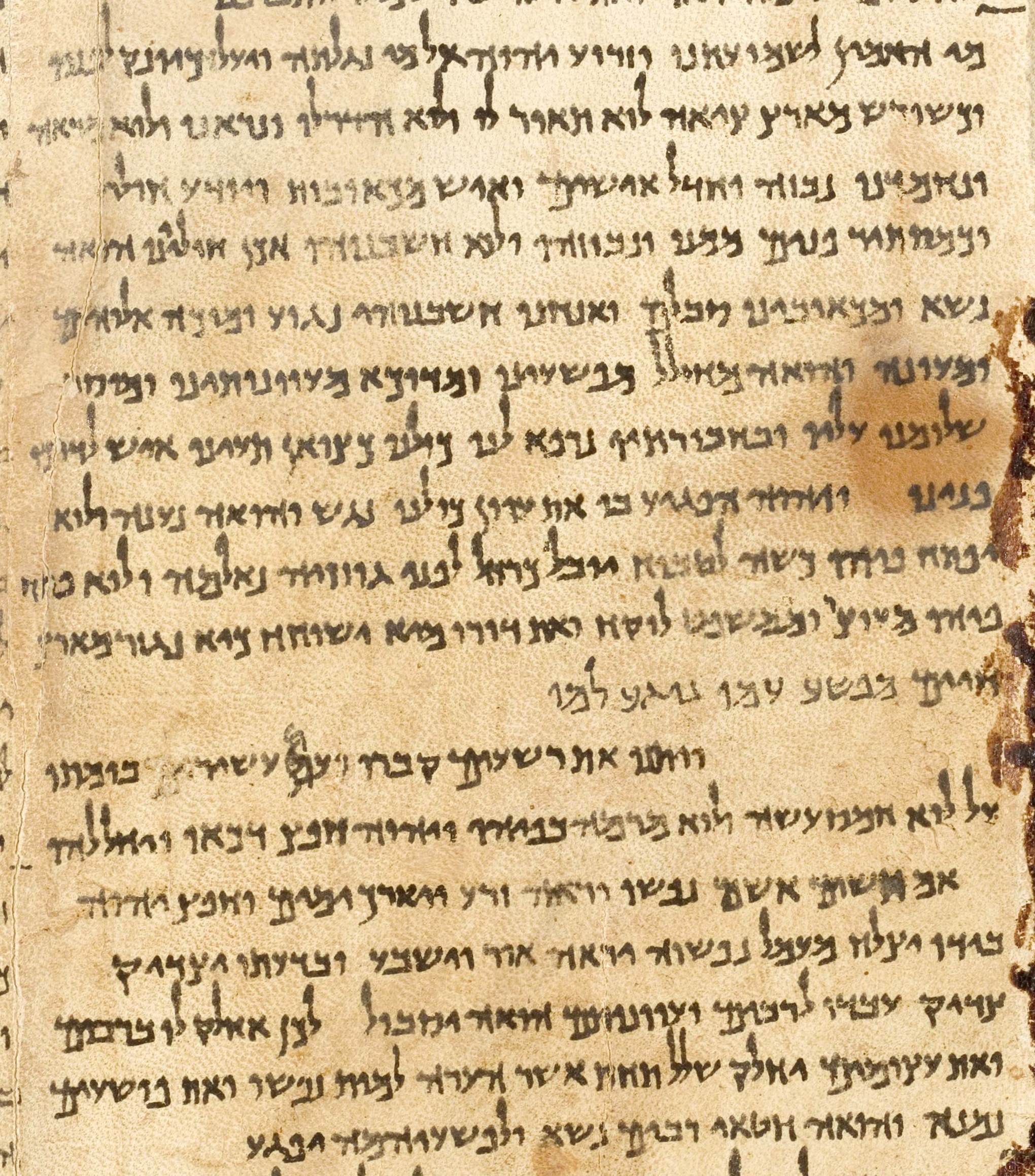
The Great Isaiah Scroll, 1QIsaᵃ, supplies a much clearer before-Christianity anchor. The Israel Museum dates it to about 125 BC and describes its 54 columns as containing all 66 chapters. The servant passage in Isaiah 52:13–53:12 therefore existed before Jesus. The manuscript establishes an early copy, not the original date of composition and not the truth of a proposed fulfillment.
The passage describes humiliation and exaltation, undeserved suffering, the bearing of others’ wrongdoing, language of death and burial, and a subsequent fruitful vindication. This sequence gives substance to a Christian reading: God’s saving purpose can be carried through the suffering of a righteous servant. Acts 8:26–35 explicitly makes Jesus the subject of an explanation beginning with Isaiah 53:7–8. Paul’s received proclamation in 1 Corinthians 15:3–8 joins death for sins, burial, resurrection and appearances with fulfillment of Scripture. It does not identify Isaiah as the sole text Paul had in mind.
Isaiah 53:11, World English Bible: “My righteous servant will justify many by the knowledge of himself; and he will bear their iniquities.” This is the servant’s saving role in the poem; identifying him is a further question.
Acts 8:35, World English Bible: “Philip opened his mouth, and beginning from this Scripture, preached to him about Jesus.” Acts supplies an explicit Christian interpretation, not a new date for Isaiah’s text.
That is a positive reason to investigate Christianity’s central account of God’s rescue. It is not yet a demonstration that Isaiah names Jesus. The passage supplies no personal name, date or explicit reference to Roman crucifixion. Isaiah 49:3 calls the servant Israel; 49:5–6 gives the servant a mission to restore Israel. The relation between the people and their representative needs interpretation. A singular figure can personify a community, so singular pronouns alone do not settle the issue.
Jewish interpretations have included national, individual and messianic readings. Marc Brettler and Amy-Jill Levine’s study favors an unidentified individual in the exilic setting while discussing broader national symbolism and the diversity of interpretation. A Christian cannot fairly claim that all ancient Jews agreed on a future dying Jesus-like Messiah, or that a collective reading was invented only to evade Christianity. Conversely, one use of Israel as servant does not automatically settle every servant passage.
The Christian reading must explain the whole poem, including the servant’s offspring and prolonged days in 53:10. Christians can connect these to the fruit of his work and life beyond death, but that is a theological reading, not a literal biographical detail that all readers must grant. Jewish alternatives must likewise account for the innocent suffering, relation to the speakers and vindication. The question is which account best explains the text in its context and any warranted later fulfillment. Brettler and Levine instead interpret the death language as extreme suffering followed by recovery. Christians must defend their reading against that alternative; the age of the scroll cannot decide it.
A second test concerns the fulfillment sources. Gospel authors knew Israel’s Scriptures. A reported resemblance may reflect remembered events, scriptural interpretation, narrative shaping, or a combination; its precise status needs argument. Matthew 27:57–60 identifies Joseph of Arimathea as rich and describes the burial. Isaiah’s earlier rich-man language does not independently verify Matthew’s detail. We cannot count the prediction, an informed narrative and our identification as three independent witnesses.
Dating the passage before Jesus does rule out Christian composition of Isaiah 53 after his death. It does not establish all details of the Passion accounts or prove resurrection and atonement. The Christian case becomes stronger through a coherent reading joined to independently assessed testimony about Jesus, rather than by treating a manuscript photograph as a verdict on theology.
Daniel and the limits of a manuscript date
Daniel shows why a biblical example must not receive easier treatment. Daniel 11 gives a detailed sequence of conflict commonly connected with the Ptolemaic and Seleucid kingdoms and Antiochus IV’s persecution. Critical scholars argue that its close correspondence with the crisis, followed by a different trajectory in 11:40–45 from Antiochus’s known final campaign and death, locates this vision during the second-century-BC crisis. That is a historical and literary argument, not merely a refusal to allow miracles.
Daniel 11:45, selected text, World English Bible: “yet he will come to his end, and no one will help him.” Whether the king here is Antiochus or a future opponent is part of the interpretive dispute.
Defenders of an earlier Daniel have replies. Roger Beckwith argues that earlier Jewish works contain allusions to Daniel’s visions. The argument depends on the dates of those works and on demonstrating which text used which. Some Christian interpreters also locate the closing verses in a future fulfillment rather than Antiochus’s death. The NET Bible’s study note argues that rulers and time periods already shift within the chapter, allowing such a transition. That reading must still explain this particular transition and is not the same claim as a completely fulfilled ancient forecast. Neither side is helped by treating its interpretation as the date printed on a surviving sixth-century copy.
Material evidence also needs care. A 2025 radiocarbon study gives the Daniel manuscript 4Q114 a calibrated range of 230–160 BC and explicitly notes its overlap with the proposed Maccabean period of composition. This range is not a precise year, an ink date or proof of sixth-century authorship. It challenges careless claims about how late the oldest evidence must be without settling the date of every vision.
The same rule corrects other popular examples. Alexander’s siege of Tyre was in 332 BC, before second-century-BC scrolls; those scrolls cannot, by themselves, prove a prophecy preceded that siege. Tyre’s subsequent Greek and Roman history and the modern city require care with a claim that it was never rebuilt. Babylon continued to be occupied after Cyrus’s conquest in 539 BC. For Isaiah 44–45, the naming of Cyrus is clear, but the date of those particular passages is part of the dispute: the standard critical account places Isaiah 40–55 in the sixth-century exile. None of these becomes an uncontested success by appearing in a catalogue.
Ezekiel 44:1–3 concerns the east gate of the sanctuary in a temple vision. Identifying it with today’s sealed Golden Gate in Jerusalem requires a separate argument; a photograph of the city gate cannot supply it. These examples are not all refuted by one objection, but each needs its own text, date and fulfillment analysis before it can carry evidential weight.
Why prophecy totals are not probabilities
There is no defensible religious probability in saying that the Bible has fifty secure prophecies and the Qur’an five without publishing the cases and their criteria. A verse, a cluster of details and a repeated account may be counted differently. Broad predictions have more possible matches than narrow ones. A list selected after the events hides unsuccessful or disputed candidates.
Nor may we multiply guessed probabilities as if each item were independent. A Gospel writer’s knowledge of Scripture can connect several apparent fulfillments. Several political reversals can share the same historical causes. Even if a defensible probability for ordinary prediction were available, converting it into the probability that an entire religion is true would require additional assumptions about competing explanations and prior evidence.
The Roman recovery was remarkable. Remarkable does not mean that its probability was measured. Naming two possible outcomes does not make the chance one half; describing Roman weakness does not establish a ten-percent chance. The proper response to uncertainty is to identify it, not decorate it with a number.

A sign and the God it points toward
The Bible itself prevents a simple equation between successful prediction and unrestricted authority. Deuteronomy 18:20–22 treats a failed word spoken in God’s name as a reason not to fear that prophet. Deuteronomy 13:1–5 also envisages an effective sign that accompanies an invitation to follow other gods and rejects that invitation. The passages belong to ancient Israel’s covenant law, including severe penalties. Citing their distinction here does not prescribe punishment for contemporary religious disagreement.
This is an internal biblical rule of discernment, not a proof of biblical authority to someone who does not yet accept it. Its logical point is useful more broadly: establishing one unusual event and deciding whose authority it warrants are separate tasks. A sign must be related to its claimed message; an event does not automatically certify every later interpretation of it.
For Islam’s Roman argument, this means testing the pre-event premise and the victory endpoint before drawing conclusions about revelation. Rejecting an unsupported certainty does not require accusing Muhammad or a later editor of deception. For Christianity, the positive invitation is more specific than counting predictions: examine whether Jesus’ death and vindication truly disclose the God who saves through the righteous servant. Isaiah provides an earlier, substantial scriptural pattern; the Christian proclamation claims that this pattern reaches fulfillment in Jesus. Its historical and theological steps can be examined rather than hidden.
Read Isaiah 52:13–53:12 as a whole, then Acts 8:26–35 and 1 Corinthians 15:3–8. Ask what is already present in Isaiah, what the Christian witnesses claim happened, and what reasons identify Jesus as its fulfillment. That comparison gives access to the Christian case while keeping its real burden of proof visible. A well-tested prophecy can strengthen a cumulative case for faith; a tally of untested matches cannot do its work.