


The Dead Sea Scrolls make parts of the Bible's transmission history directly testable. Ancient Jewish manuscripts show substantial continuity with later Hebrew biblical texts, but also differences that cannot all be reduced to spelling. The Great Isaiah Scroll establishes that Isaiah 53 existed before Christianity. It does not establish a particular interpretation of that chapter, an unchanged New Testament, or the divine origin of either collection.
The useful question is therefore specific: what does a surviving copy allow us to say about an earlier text, and which allegations of alteration does it rule out?
Israel Antiquities Authority: Qumran collection · Israel Museum: Great Isaiah Scroll, p. 2 · Emanuel Tov: Understanding the Text of the Bible (2014), pp. 89–96
A collection of manuscripts, not one ancient Bible
The first discoveries near Qumran, on the northwestern shore of the Dead Sea, came to light in 1947 through Bedouin finders. Further discoveries and excavations recovered writings from eleven caves by 1956. Most of the material consists of fragments, not complete books. The famous story about a shepherd and a thrown stone is not needed to establish the manuscripts' historical importance.
The Qumran writings generally belong to the third century BCE through the first century CE. BCE means before the Common Era; CE means the Common Era. The wider label Dead Sea Scrolls can also include finds from other sites and periods. We are concerned here with the Qumran biblical manuscripts, not treating every object found in the Judaean Desert as one dated collection.
Biblical manuscripts transmit books that now belong to the Hebrew Bible. Other writings include prayers, rules and interpretations of scripture. Hebrew is the main language, with Aramaic and Greek also represented. The mixture reveals a Jewish religious setting; it is not a bound Bible with a modern table of contents.
The Israel Antiquities Authority identifies copies or portions of every Hebrew Bible book except Esther. This does not mean every book survives completely, or every Christian Old Testament canon has been recovered. Christian traditions differ over the boundaries of that collection. Nor does possession of a work show that every group gave it identical authority. The collection includes Enoch and Jubilees alongside community literature; its contents do not fit a simple universal division into accepted Bible and rejected books.
No New Testament manuscript has been securely identified at Qumran. The scrolls illuminate the Jewish world in which Christianity emerged, but they are not a cache of Gospels or eyewitness accounts of Jesus. Arguments about New Testament copying require their own manuscripts. Many scholars connect the Qumran material with the Essenes, an ancient Jewish group, but the precise relationship and the origins of the whole collection remain debated.

What dating actually tells us
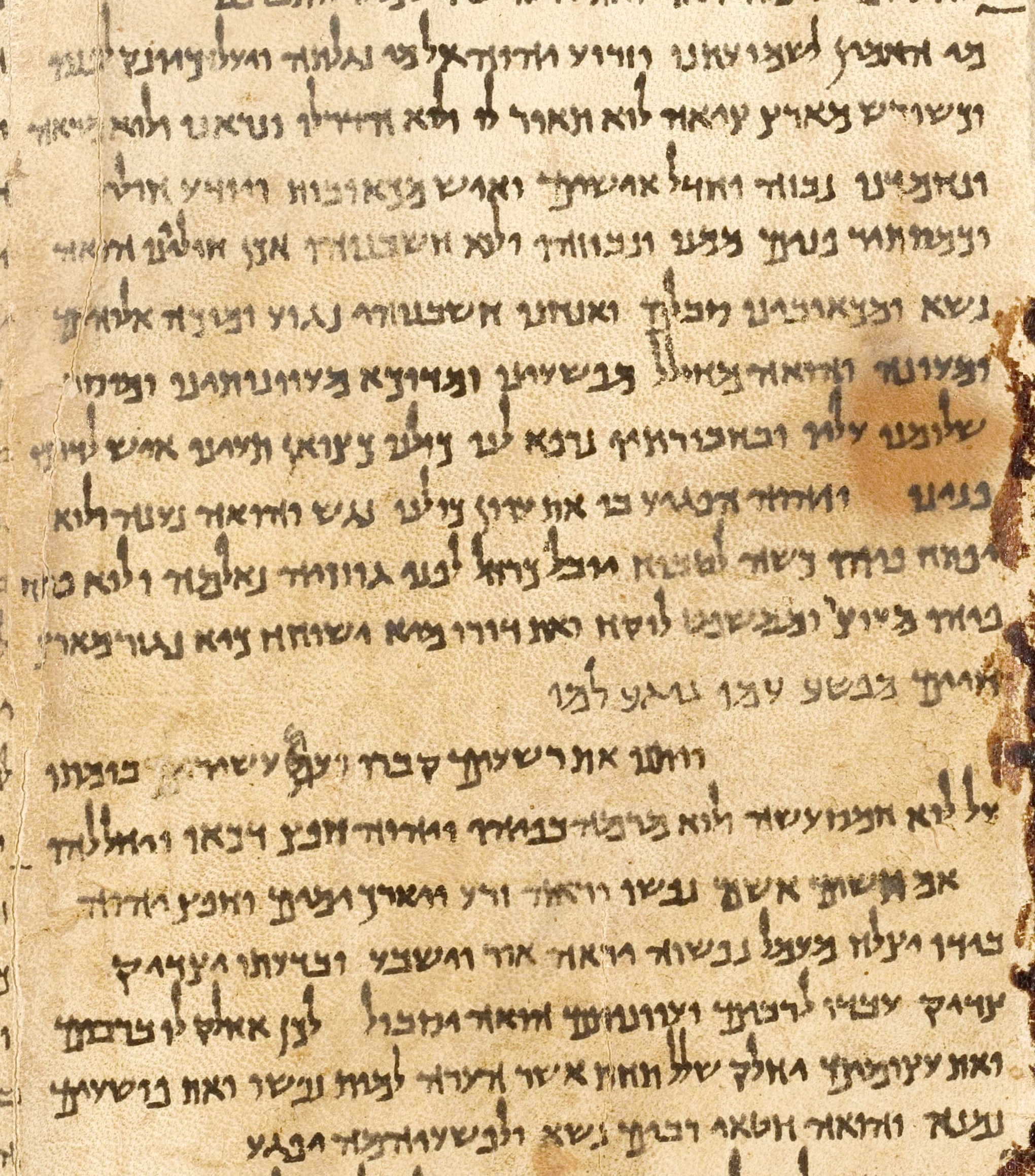
The Great Isaiah Scroll bears the scholarly identifier 1QIsaᵃ: Cave 1 at Qumran, Isaiah manuscript a. The Israel Museum describes 54 columns containing the whole book, although there are small damaged areas, and gives an approximate date of 125 BCE. It is a copy, not an original manuscript in the prophet's hand. Establishing that a passage appears in a pre-Christian copy establishes that it existed by then; it does not establish the precise date of its composition.
Handwriting comparison, called palaeography, and radiocarbon testing contribute different kinds of evidence. Handwriting is compared with other ancient scripts. Radiocarbon analysis estimates the age of the organic writing material within a range; it does not produce an exact calendar date for the act of writing. The useful conclusion here is pre-Christian antiquity, not a claim that a laboratory measured the year 125 BCE.
The chronological gain was enormous, but the situation before 1947 was not complete ignorance. Major medieval Hebrew codices supplied extensive texts; a codex is a book with pages rather than a roll. Earlier evidence also existed. Cambridge's Nash Papyrus, presented to the library in 1903 and dated to the second century BCE, contains a short biblical selection. A fragment, an extensive manuscript and a complete collection answer different questions. The scrolls greatly enlarged the early Hebrew evidence rather than creating it from nothing.
Continuity and diversity can both be true
The Masoretic Text is the traditional Hebrew text preserved by Jewish scribes and scholars, with the vocalization and other reading apparatus associated with the Masoretes. Its surviving medieval witnesses are much later than the Qumran scrolls. Similarity between them shows that substantial textual continuity reaches back well before those medieval copies. It does not mean that medieval scribes produced the earlier scrolls, or that one copying practice explains every witness.
Isaiah offers a useful comparison within the early finds themselves. The Great Isaiah Scroll, manuscript a, has distinctive spelling and linguistic forms. The fragmentary Isaiah manuscript b is often closer to the later Masoretic tradition. As Lawrence Schiffman explains, the two witnesses already show different forms of the text coexisting. We should not treat the best-preserved scroll as automatically the best reading at every disputed word.
Isaiah 53:11 provides a manageable example. The Great Isaiah Scroll includes אור, the Hebrew word for light, after the verb for seeing; the standard Masoretic text lacks that word. The ESV prints the shorter reading in the main text and gives the Dead Sea Scroll alternative in its footnote: “he shall see light.” The footnote lets readers distinguish a manuscript difference from a translator merely choosing a different English expression.
The corresponding short Hebrew readings are “יראה ישבע” in the Masoretic Text and “יראה אור וישבע” in 1QIsaᵃ (Hebrew readings reproduced in Anthony Ferguson’s witness table). Our brief rendering of the Masoretic phrase is “he will see; he will be satisfied”. The quoted ESV footnote above supplies an English rendering of the reading with light. These are textual readings, not a decision about the servant’s identity.
This variant is not a new chapter about an entirely different subject. Nevertheless, it changes the wording and potentially affects how the servant's outcome is understood. Calling every difference a harmless spelling adjustment conceals evidence. Calling the entire book a fabrication because one word differs makes the opposite mistake. A variant has to be assessed in its sentence and in the wider manuscript evidence.
Jeremiah shows why we also cannot generalize from Isaiah to every biblical book. The Septuagint is the ancient Greek translation tradition of Jewish scriptures. Qumran fragments include witnesses associated with the longer Hebrew Jeremiah and others supporting readings of the shorter form behind the Greek. In Jeremiah 10, for example, 4QJerᵇ preserves evidence relevant to the shorter arrangement. This is a question of differing textual editions, not just spelling. The fragments do not give us a complete second Jeremiah, but they show that some Greek differences reflect an earlier Hebrew text rather than a Greek translator simply inventing them.
Why a preservation percentage can mislead
A numerical comparison needs defined manuscripts, a counting unit and a method. Counting letters is different from counting words. Counting only readable shared passages excludes missing material. A long omission can count as one variant or many, while thousands of spelling differences may have little effect on a translation. Without those choices, “95% identical” describes no reproducible test.
Even a properly calculated similarity score is not the probability that a text was falsified. That probability would require a defined hypothesis about who changed what and when, together with evidence for competing explanations. Manuscript abundance also does not make the surviving witnesses independent: several copies may descend from the same earlier copy. A numerical confidence claim about the entire Bible cannot be extracted from one comparison of Isaiah.
The better result is passage-specific: name the witnesses, show their readings, explain the judgment and retain any uncertainty. A footnote identifying a significant variant gives the reader more useful information than an unsupported guarantee. Some alterations can be detected; no collection of surviving copies establishes that every change in every lost ancestor can be recovered.
Emanuel Tov: Understanding the Text of the Bible (2014), pp. 89–96
Isaiah 53: an ancient passage and a disputed interpretation
The Great Isaiah Scroll includes the passage now numbered Isaiah 52:13–53:12. The text describes a servant who suffers, bears others' wrongdoing and is vindicated. Its existence before Christianity rules out the claim that Christians composed this passage after Jesus' death and inserted it into Isaiah. That is a substantial historical result. It is not a result about which person the passage predicts.
Acts 8:26–35 offers a clear Christian interpretation: Philip starts from the servant passage and tells the Ethiopian reader about Jesus. In 1 Peter 2:21–25, Christ bears sins through his suffering so that people may live rightly before God; the language echoes Isaiah's wounds, healing and wandering sheep. The earlier Jewish manuscript confirms that the passage Christians use to explain salvation was not created by the church for that purpose. These New Testament passages are evidence for the Christian reading, not independent proof that it is correct.
Acts 8:35 describes Philip’s response: “beginning from this Scripture, preached to him about Jesus”. 1 Peter 2:24 explains the Christian claim: “He himself bore our sins in his body on the tree, that we, having died to sins, might live to righteousness.” (World English Bible). The passages show how Christians connect Isaiah with Jesus and salvation; they do not make manuscript age a proof of fulfillment.
There is a serious Jewish alternative. Rashi identifies the servant with Israel, understanding the suffering in relation to the nations. This has a contextual basis: Isaiah 49:3 explicitly calls Israel God's servant. Verses 5–6 also give the servant the task of restoring Israel, so the relationship between the servant and the people requires interpretation. Jewish interpretation is not uniform, and citing Rashi does not exhaust it. A Christian case must explain how an individual or representative reading relates to that collective language, the passage's details and the wider book. The age of the parchment cannot answer those questions.
It would also be too quick to treat Isaiah 53:11's word light as a laboratory proof of resurrection. A textual reading and its theological interpretation are separate judgments. The manuscript gives readers an older witness to examine; the case about Jesus must still be argued from texts, context and historical evidence about him.

Israel Museum: Great Isaiah Scroll, p. 2 · Isaiah 53:11, ESV textual footnote
What a Muslim objection would still need to show
The Arabic term taḥrīf concerns distortion. The TDV Muslim scholarly encyclopedia describes different views about changes to scripture's wording and meaning. Qur'an 3:78 concerns misrepresentation through speech; 2:79 also condemns people writing something and attributing it to God. Ibn Kathir's commentary on 3:78, in the inspected English abridgment, includes additions and deletions in existing copies. A textual-corruption position is real, not simply a misunderstanding of a verse about speech. But none of these statements identifies a particular altered word in Isaiah or dates that change.
Consider three possible claims. If the claim is that the church invented Isaiah 53 after Jesus, the earlier Jewish copy refutes it. If the claim is that wording changed at some earlier stage before our surviving witnesses, Qumran cannot automatically rule it out. If the objection is that Christians misinterpret an authentic passage, agreement between manuscripts does not answer it. These are different arguments with different evidence requirements.
A Muslim critic can therefore accept the scrolls' antiquity while denying the Christian interpretation. Shabir Ally explicitly distinguishes their historical value from religious authority. IslamWeb represents a position that accepts surviving truth alongside alteration and judges earlier scripture by the Qur'an. Qur'an 5:48 itself claims authority in relation to earlier scripture. On that understanding, an ancient Isaiah is compatible with Islam; manuscript age alone does not refute it.
This reply succeeds against an argument that treats preservation as proof of inspiration. But using the Qur'an as the deciding authority raises a further question for someone comparing religions: why accept that authority? A believer may have reasons beyond manuscript evidence; those reasons need their own examination. Disagreement with the Qur'an alone does not independently demonstrate that a biblical passage was changed. Equally, demonstrating an ancient biblical reading does not establish that it came from God.
The same standard applies to Christians. They must not assume biblical authority to prove biblical authority, or present every manuscript difference as insignificant. They can make a narrower positive case: the Hebrew Bible is an accessible ancient body of evidence, with pre-Christian Jewish witnesses that constrain allegations of late Christian invention. Its textual history deserves investigation rather than wholesale dismissal.
For someone comparing Islam and Christianity, this opens a concrete route toward the Christian claim about salvation. Read Isaiah's servant passage in context, then examine why Acts connects it to Jesus and whether the evidence supports that connection. The scrolls make the earlier side of that comparison historically firmer. They do not relieve either tradition of the responsibility to explain its reading.