


The answer depends on what the verse establishes
The scientific examples examined here do not establish that the Qur’an could only have come from God. A verse may fit a discovery without having clearly predicted it. Qur’an 21:30 and 51:47 allow readings broader than modern cosmology, and the existence of ancient accounts of development in the womb makes claims of wholly unprecedented embryology difficult to sustain. None of this, by itself, proves the Qur’an false or Christianity true.
For Muslims, the Qur’an is God’s revelation to Muhammad. Scientific-miracle arguments add a particular reason for accepting that belief: the text supposedly contains knowledge beyond the reach of its first human audience. That argument deserves a fair test. It also needs to be distinguished from a believer finding spiritual meaning in nature. A meaningful sign need not function as a uniquely identifying scientific prediction. A correspondence may strengthen someone’s existing belief without amounting to decisive proof; its evidential weight still depends on competing readings and on how the examples were selected.
Qur’an 51:47 and al-Tabari’s Arabic commentary · Elsakaan and Longo, The Embryo Development in Quranic Verses (2016), pp.921–938
What would count as a prediction?
Suppose an old text describes an impressive sky. Learning astronomy may deepen a reader’s appreciation of it. But if the same wording could suit a static universe, an expanding universe, or simply a vast sky, it does little to distinguish those possibilities. A stronger prediction says something that would have been wrong if the world had turned out differently.
Ask four linked questions. Was the wording established before the discovery? What does it mean in its language and context? Does it select the discovery over plausible alternatives? Was the alleged knowledge already available through observation or earlier ideas? Equations are unnecessary: an ordinary sentence can be precise. Equally, a text need not have produced an actual discovery to contain an overlooked prediction. Earlier interpretation is evidence about clarity, not an infallible limit on meaning.
This avoids two shortcuts. An old text is not automatically predictive, and an interpretation first proposed after a discovery is not automatically false. The question is whether the independent wording carries the scientific information, or whether the interpreter supplies the decisive detail after learning the answer. That second process is retrospective matching, sometimes called concordism.

21:30: joined heavens and earth
Qur’an 21:30 describes the heavens and earth using ratq, then says fa-fataqnāhumā: they were closed or joined, then opened or separated. The verse continues by connecting water with every living thing and calling its audience to belief. The Arabic presents a theological argument; identifying the opening with the Big Bang is an additional interpretation.
Pickthall renders the relevant clause in Qur’an 21:30 as “the heavens and the earth were of one piece, then We parted them” (The Meaning of the Glorious Koran, 1930). The full verse also mentions water and living things. This is the wording to interpret, not a scientific model specified by the quotation itself.
Premodern commentary is genuinely varied. Al-Tabari records a joined heaven and earth separated by air, a division into heavens and earths, and an opening of the sky with rain and the ground with vegetation. He prefers the rain-and-vegetation account because the following clause mentions water and life. Physical separation is therefore not a modern invention, but neither was the text restricted to one cosmological description.
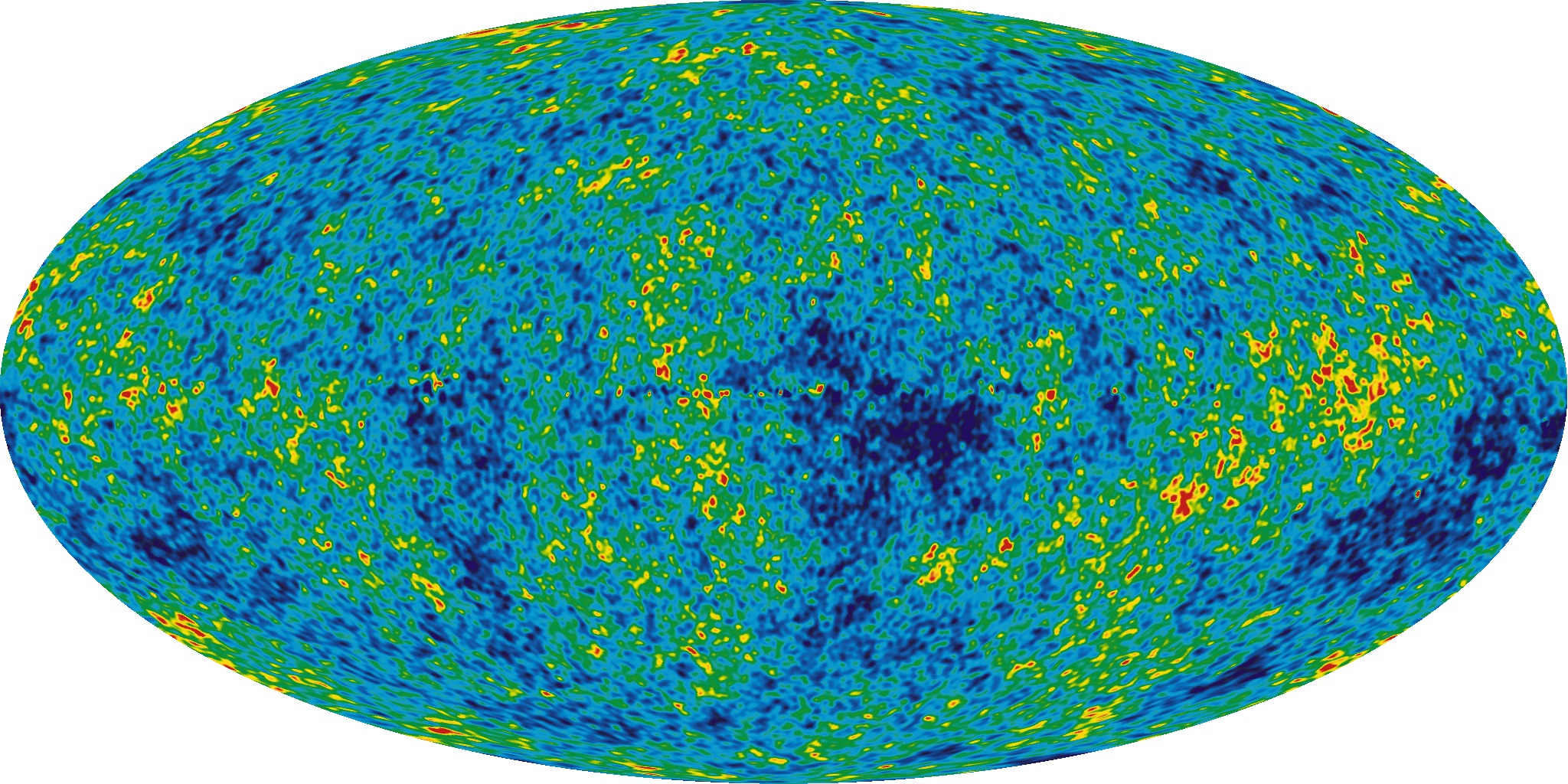
Modern Big Bang cosmology describes an early hot, dense universe that expanded and cooled. The Earth as a formed planet belongs much later in that history; the theory is not simply two existing objects, sky and Earth, pulled apart. Nor is it an ordinary explosion into surrounding empty space. Observations such as cosmic expansion and the cosmic microwave background—the remaining radiation from the early universe—constrain this scientific account. NASA’s WMAP observations map small temperature differences in that background; the map is measured data, not a photograph of creation.
A serious Muslim defense answers the Earth objection: the phrase can refer to what later became heaven and Earth. Umar Nasser’s Ahmadi Muslim defense makes this argument, rather than imagining the present planet at the beginning. That is a possible broad reading, so the objection that the Earth came later does not alone defeat it. But the same flexibility leaves the verse without the specific information that distinguishes modern cosmology from other stories of unity followed by separation. Compatibility survives; a uniquely identifying scientific prediction has not been established.
51:47: spacious or still expanding?
Qur’an 51:47 includes wa-innā la-mūsiʿūn. Muhammad Asad renders the key idea as “steadily expanding it” and explicitly connects it with modern cosmic expansion. That translation makes the argument easy to understand: the heavens are not merely large; their scale continues to increase.
The older evidence must also be stated accurately. Al-Tabari explains capacity and power to create, while transmitting a reading that God made the heaven spacious. Ibn Kathir likewise explains its regions as made spacious. It would be false to say that all earlier commentators understood only wealth or generosity. Yet making a heaven broad and describing a continuing increase in distances across the universe are different claims.
The Quranic Arabic Corpus identifies mūsiʿūn as an active participle, a form describing an agent or characteristic. Calling it an active participle does not by itself settle the timing. Qur’an 18:23 uses an active participle in a statement about doing something tomorrow. This comparison does not rule out ongoing expansion in 51:47; it shows why grammar alone cannot force that interpretation. Context and usage still have to decide.
A Muslim may therefore reasonably defend expansion as an intended meaning that earlier readers did not fully recognize. The reply is not that God could never communicate that way. It is that a possible divine intention is not independent evidence that the intention is divine. The argument needs to explain why this particular meaning follows more strongly than the older alternatives before the modern discovery selects it.
Development in the womb: avoid two exaggerations
Qur’an 23:12–14 moves from clay to a drop in a secure place, then through ʿalaqa and muḍgha (a lump) to bones clothed with flesh. Translations differ over the descriptive terms. Treating ʿalaqa as nothing but a blood clot ignores the competing emphasis on clinging or attachment. Conversely, selecting a modern biological label does not demonstrate that the Arabic uniquely encodes that scientific concept.
In Qur’an 23:14, Pickthall renders part of the sequence: “then fashioned We the little lump bones, then clothed the bones with flesh” (The Meaning of the Glorious Koran, 1930). This shows one translator’s wording; it does not resolve the competing meanings of the terms or establish a modern anatomical correspondence.
Ancient Greek medicine already discussed prenatal development. Nesma Elsakaan and Michele Longo compare Qur’anic terminology with Greek theories in their 2016 study, especially the Hippocratic work On the Nature of the Child. They record both similarities and differences. Their conclusion treats dependence as a hypothesis requiring further investigation, not a proven act of copying.
The distinction matters in both directions. Earlier accounts challenge the claim that describing stages in the womb was wholly unknown before Islam. Their existence does not, by itself, establish access to them in Muhammad’s setting. But a resemblance to Galen or Hippocratic medicine does not show that Muhammad read a particular book, heard a particular teacher, or borrowed a passage directly. Differences also matter; “nearly word for word” is too strong. This limited comparison tests the claim of unprecedented description; it does not settle every proposed modern anatomical correspondence or the order of tissue formation.
Give biblical science claims the same test
Isaiah 40:22 pictures God stretching the heavens like a curtain and spreading them like a tent. A Christian can connect that language with an expanding universe. But the similes also make sense without modern cosmology. In context, the passage contrasts God’s greatness with the smallness of people and rulers. It does not specify how distances between galaxies change with time.
Isaiah 40:22 describes God as the one “who stretches out the heavens like a curtain, and spreads them out like a tent to dwell in” (World English Bible). These are the actual similes being compared; identifying them with a scientific discovery still requires an argument.
It would be special pleading to reject an expansive reading of Qur’an 51:47 for being broad, then announce that Isaiah’s tent proves modern astronomy was supernaturally predicted. Both claims need the same linguistic and scientific checks. This does not erase differences between the books or decide every science-related passage in either. It prevents the desired religious conclusion from choosing the standard.
Nor can a list of apparent matches responsibly be converted into a 75/25 victory score. Without a defined set of claims, a method for counting failures and alternatives, and justified probabilities, the percentage is a personal impression disguised as a measurement. Several independently strong pieces of evidence can reinforce each other; several readings adjusted to known discoveries may repeat the same interpretive weakness.

A concrete reason to investigate Christian testimony
The next step is not to declare the Bible true because a Qur’anic argument is weak. It is to examine the kind of evidence Christianity actually offers for its central claim about Jesus. Paul’s first letter to the Corinthians, whose composition is dated to the 50s CE, provides a specific starting point. In 1 Corinthians 15:3–8, Paul reports a received message about Jesus’ death, burial, resurrection and appearances, naming Cephas and James among the recipients; in verse 8 he adds his own claim to an appearance. In verses 14–17 he explicitly makes the value of Christian faith depend on the resurrection being real.
Paul introduces the message he received in 1 Corinthians 15:3–4: “that Christ died for our sins according to the Scriptures, that he was buried, that he was raised on the third day according to the Scriptures” (World English Bible). This is a concrete Christian proclamation to investigate, not independent proof that the reported event occurred.
That gives an investigator something more definite than a resemblance between a poetic phrase and a later discovery: an early author, an identifiable claim, named people and a stated consequence if the event did not occur. The letter is positive evidence that resurrection proclamation was already present in early Christianity. It is not a collection of separately preserved statements from everyone Paul names, and an early report does not by itself prove a miracle.
The same discipline now asks when the testimony arose, how Paul knew what he reports, how other sources relate to it, and which explanation best accounts for it. Accurate names, places or titles can support a writer’s knowledge of a setting; they cannot certify every event or God’s authorship of a whole book. Preservation, historical reliability and divine authority remain separate questions.
For someone comparing Islam and Christianity, this is a reason to investigate the Christian claim on its actual evidence rather than dismiss it because a modern translation of the Qur’an sounds scientific. Other Islamic arguments require their own examination; this article has not ranked the complete evidential cases for the two religions. The cases above do not supply an exclusive scientific credential that settles the comparison in Islam’s favor. They leave the central historical question open to examination: what best explains the early testimony that God raised Jesus?