


The God described by the Qur’an is not interchangeable with the God revealed in the Christian Bible. The decisive difference is God’s identity in relation to Jesus: Christianity confesses the eternal Son who became human; Islam rejects divine sonship and the worship of Jesus. If these claims concern the same reality in the same sense, both cannot be true.
That conclusion needs a precise boundary. It establishes incompatible accounts of revelation, not the existence of two actual creators. Muslims intend to address the Creator of Abraham; Qur’an 29:46 expressly asserts a common God with the People of the Book. Philosophers and Christians disagree about whether shared reference survives profound doctrinal error. This investigation argues that Islam does not preserve the Christian revelation of God, without pretending that comparison alone settles every question about reference or salvation.
Qur’an 4:171 — Jesus, Word, and divine sonship · John 1:1–18, World English Bible · Nostra aetate (1965), section 3
What does “the same God” mean?
Three different claims often hide inside that phrase. People may mean that both communities intend to worship the one Creator, that their descriptions of him agree, or that their worship receives the same theological evaluation. The first does not logically establish the second or third. Two people can disagree about someone while intending the same person; that ordinary possibility must not disappear when we discuss religion.
Qur’an 29:46 supports the Muslim claim to continuity with earlier revelation. It is evidence of what the Qur’an claims, not independent proof that its description agrees with the New Testament. Likewise, the Arabic word Allah does not establish an Islamic origin for every use of the word: Arabic Christians use it too. The dispute cannot be settled by treating a language as a creed.
Our test is therefore narrower and more useful: does the Qur’anic account retain or contradict what Christianity regards as essential to God’s self-disclosure? The argument requires an explicit principle: two purported revelations cannot both correctly affirm and deny the same essential identity in the same respect. This principle does not tell us which revelation is true. It tells us why their differences require investigation.
Yaqeen — Jesus: A Foundation for Dialogue Between Muslims and Christians · Nostra aetate (1965), section 3
Christian monotheism starts before the later creeds
Christianity does not begin by adding two lesser gods to a greater one. In 1 Corinthians 8:4–6 Paul affirms one God while locating all things in relation to the Father and through Jesus Christ. In John 1:1–3 the Word is with God, is divine, and is the one through whom creation comes to be. John 1:14 identifies the coming of the Word in human life. These passages give the later doctrine its problem to explain: personal distinction without treating the Son as a creature outside the one God.
The Nicene creed of 325 answers that problem by confessing the Son as begotten, not made, of one substance with the Father. The expanded creed associated with Constantinople in 381 also articulates the confession of the Holy Spirit. Catholic, Orthodox, and Nicene Protestant Christianity share the basic confession of one God as Father, Son, and Holy Spirit; non-Nicene groups should not be silently included in that claim.
Eternal sonship is not the same claim as incarnation. The Son does not begin to exist when Jesus is born. Incarnation means the eternal Son assumes human life; it does not mean God acquires a wife, produces a second deity, or changes his divine nature into flesh. The distinction matters because rejecting physical divine reproduction does not, by itself, answer the doctrine Christians actually confess.
The Qur’an honors Jesus and rejects the Christian identification
Qur’an 4:171 addresses the People of the Book, calls Jesus Messiah and messenger, and describes him as God’s word directed to Mary and a spirit from him. The same passage rejects “Three” and divine sonship. Modern translations sometimes insert explanations into this description; an explanatory addition about a created spirit must not be mistaken for a separate Arabic phrase.
Surah 112 emphasizes God’s unique oneness and denies begetting and being begotten. Qur’an 5:72–75 rejects identifying God with the Messiah and describes Jesus as a messenger. Within this setting, borrowing the honorific Word cannot make the Qur’an affirm John’s eternal, incarnate Word. A shared title receives its meaning from its surrounding claims.
Nor should a Christian argument depend on saying that the Qur’an only attacks three gods or a divine family of Father, Mary, and Jesus. Qur’an 5:116 mentions worship of Jesus and Mary; that does not by itself establish that its author defines every Christian Trinity that way. The stronger comparison uses the unmistakable disagreement over Jesus’ divine sonship. Even after physical procreation and three-god misunderstandings are removed, that disagreement remains.
Why the Son is essential to the Christian identity of God
Father is not merely a sentimental synonym for Creator in the New Testament. John 17:24 presents the Father’s love for the Son before the world’s foundation. In this account, the Father–Son relationship does not begin with creation or the birth of Jesus. God is not first a solitary being who later adopts an optional religious title.
First John 2:23 says, “Whoever denies the Son doesn’t have the Father.” Its immediate setting concerns opponents of the Johannine community, not a discussion of seventh-century Islam. Applying its principle to Islam is a Christian theological inference, not a claim that the author named Muhammad. The inference is that a revelation denying the Son cannot supply the knowledge of the Father this text describes.
A Muslim may reject this standard because the New Testament itself is disputed. That is a legitimate challenge to the argument’s premise. The verse establishes what is at stake within Christianity; it is not a neutral historical demonstration of Christianity’s truth. It nevertheless prevents us from presenting divine sonship as a minor detail that can be removed while leaving the same Christian revelation intact.
What Jesus’ prayer does—and does not—prove
A strong Muslim objection points to John 17:3: Jesus addresses the Father as the only true God and describes himself as the one sent. If we ignored that passage, our portrait of John would be selective. The Father and Jesus are genuinely distinguished, and the Christian doctrine must account for Jesus’ prayer and human obedience.
Read the rest of the same prayer. In 17:5 Jesus speaks of glory with the Father before the world existed; in 17:24 he speaks of the Father’s pre-creation love. Read those alongside John 1 rather than replacing the Gospel’s whole account with one sentence. The Nicene reading holds personal distinction and shared deity together. It does not identify Jesus with the Father.
Preexistence alone would not establish that Jesus is uncreated. The Christian reading also draws on John 1:3: everything that came into being came through the Word. Christians understand this to place the Word on the Creator’s side of the distinction between Creator and creation. A Muslim can still dispute that interpretation or the Gospel’s authority, but an alternative must explain this whole pattern alongside Jesus’ prayer and obedience.

The Nicene creed of 325 · Yaqeen — Jesus: A Foundation for Dialogue Between Muslims and Christians
Love, forgiveness, and the event at the center
A careless contrast says that Christianity offers love while Islam offers only fear or human effort. Qur’an 85:14 and 39:53 make that contrast untenable: the former joins forgiveness and love; the latter offers hope of forgiveness, with repentance in the surrounding verses. Islamic thought cannot fairly be reduced to a God without mercy.
Romans 5:6–10 makes a more distinctive claim. God’s love is shown in Christ’s death for sinners, and reconciliation comes through the death of his Son. This is not a reward for first becoming morally worthy. The Christian invitation is to trust the God who acts for his enemies and then transforms their lives. Its content depends on who Jesus is and what happened to him.
In the predominant Muslim interpretation, Qur’an 4:157–158 denies that Jesus was killed or crucified and affirms his being raised by God. The verse does not name a substitute; alternative readings and theories of the event exist. None of that licenses us to smuggle Christian redemption through the crucified divine Son into the passage. The ordinary Islamic account removes the event through which Paul explains God’s reconciling love.
Christians differ over how best to explain atonement. This comparison does not require one theory of punishment or a picture of an unwilling Son forced by the Father. Its common point is the saving death and resurrection of Jesus, the incarnate Son. Islamic mercy and Christian redemption are serious theological claims; recognizing mercy in both does not make their accounts of salvation identical.
Before Nicaea: what the historical record shows
The chronological question is important because an argument against a fourth-century invention can be tested. Paul’s first letter to the Corinthians reports the message he received: Christ died for sins, was buried, was raised, and appeared to witnesses (15:3–8). The letter belongs to the first century, centuries before Islam. It is early Christian testimony to proclamation and belief; the passage alone is not an independent verification of every reported appearance.
Around AD 112, Pliny’s letter to Trajan describes interrogated Christians and their practice of singing to Christ as to a god. The Latin in Letters 10.96.7 is preserved in the Dickinson edition, alongside the available English translation. A Roman official hostile to the movement is not endorsing its theology. His report does, however, place divine honors to Christ well before Constantine and the Nicene council.
The letters attributed to Ignatius of Antioch also call Jesus God, including the greeting and chapters 7 and 18 of Ephesians. Their traditional early-second-century dating has been challenged, so no argument here depends on an exact year. Together with the earlier Christian texts and Pliny, they make a simple claim that Nicaea invented the first divine Jesus historically inadequate.
What follows is limited but significant. Nicaea’s precise terminology had a history; Christian disagreement and doctrinal development were real. It does not follow that belief in a divine Christ first appeared when a council selected its wording. Conversely, proving that a belief is early does not prove it true. Historical continuity supplies a reason to investigate the Christian account in its own sources, rather than dismiss it as a late imperial fabrication.
Pliny and Trajan — primary-source translation and historical setting · Cambridge, Ignatius of Antioch: Letters (Selections) · The Nicene creed of 325 · Yale Bible Study — circumstances of 1 Corinthians
A manuscript and a monument
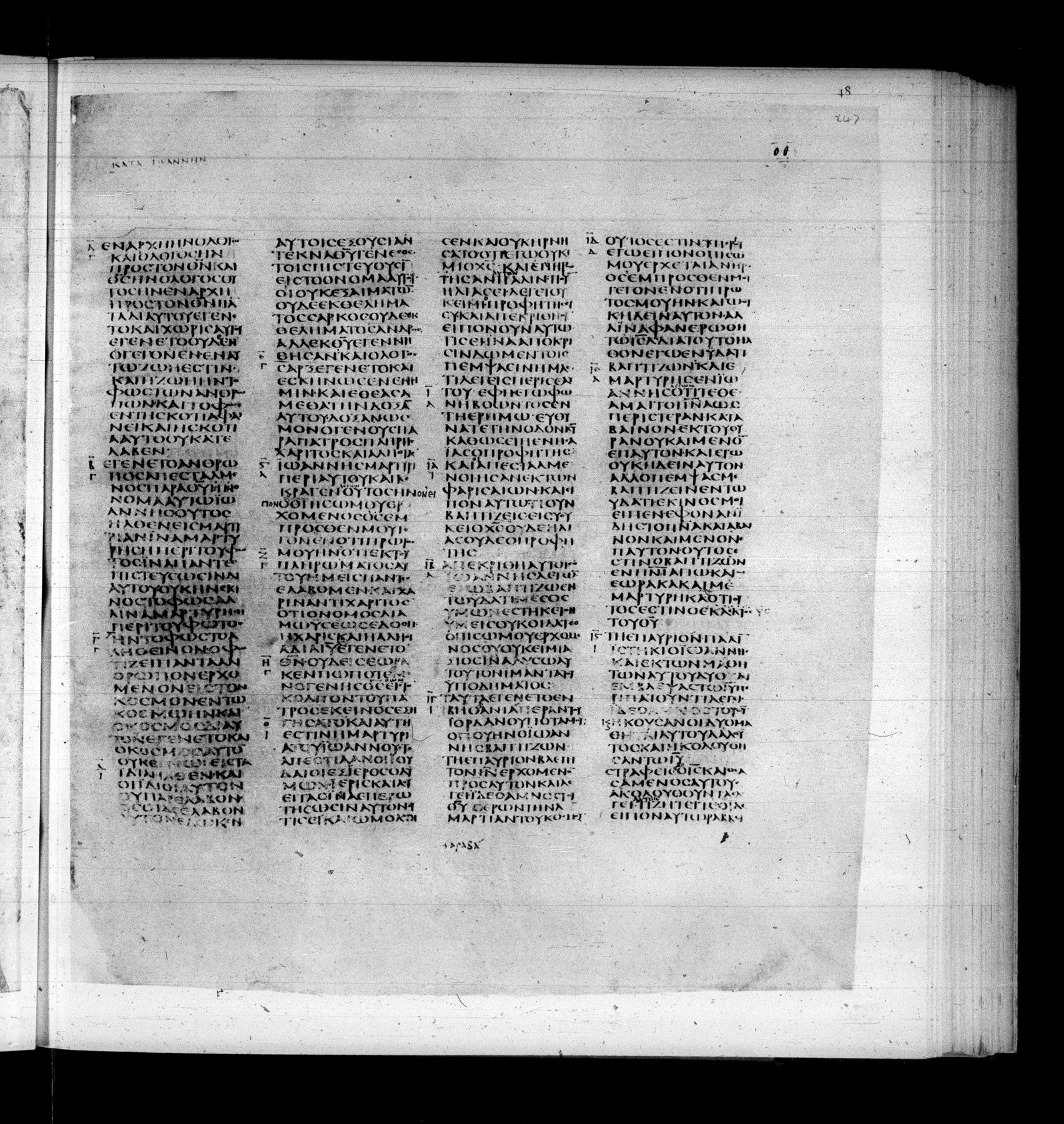
Codex Sinaiticus gives a physical checkpoint. The institutional project dates the manuscript to the fourth century by handwriting analysis. Its John page, British Library folio 247, preserves the Gospel’s opening, including the Word’s relation to God and creation. It is a copy, not John’s autograph, and its textual variants must not be concealed. Its narrower evidential value is that this Christian portrait was materially present before Islam.
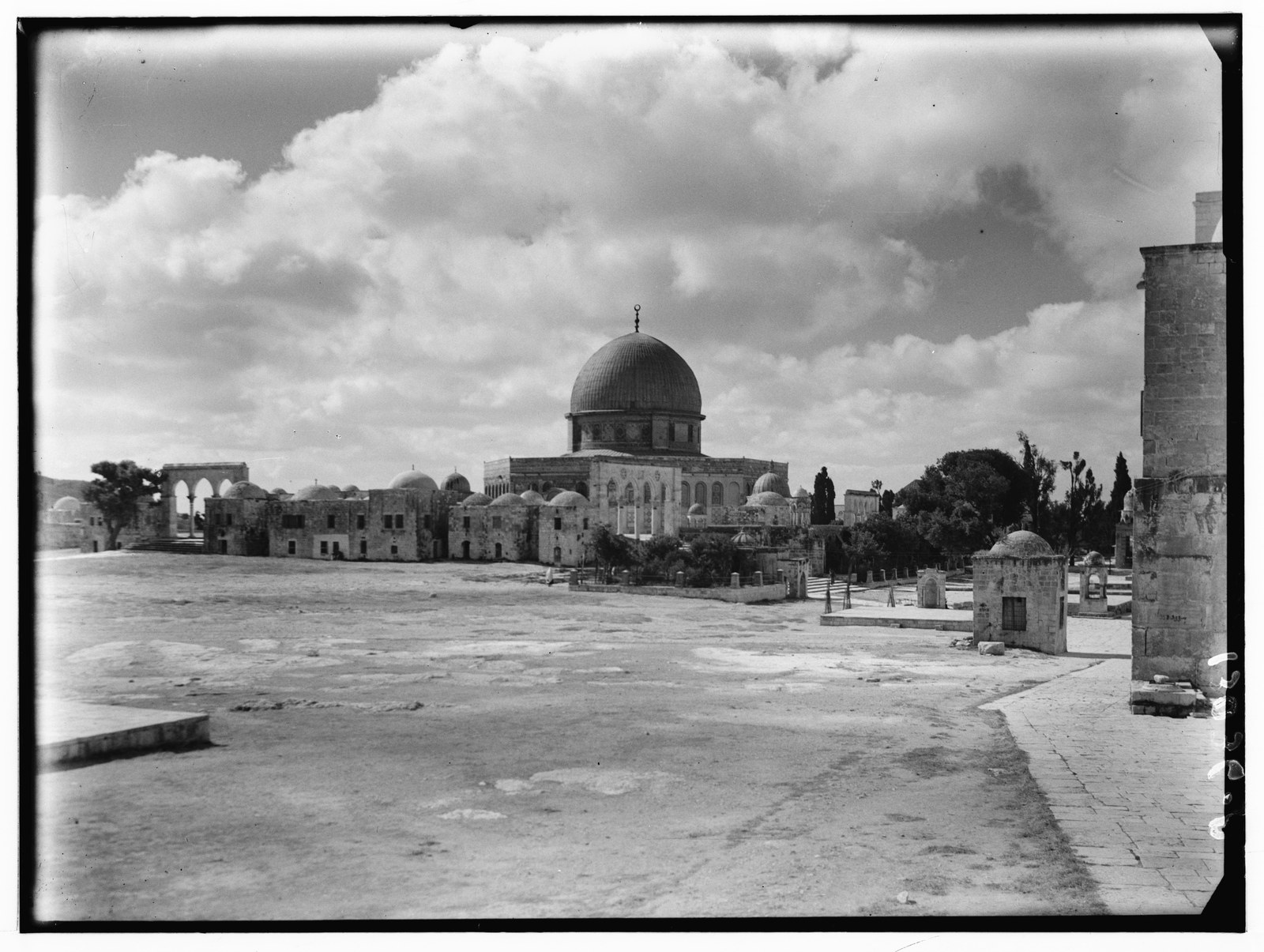
Jerusalem’s Dome of the Rock, completed in 691–692 under Abd al-Malik, supplies a different checkpoint. The Metropolitan Museum describes its Qur’anic inscriptions as promoting Islamic teaching in relation to Christianity. The monument combines that message with architectural and decorative debts to Byzantine traditions. Religious contact therefore did not eliminate the disagreement; it provided a setting in which competing claims were publicly expressed.
The manuscript and monument establish neither the incarnation nor the Qur’an’s divine origin. They show that we are dealing with historically embodied claims, not merely modern labels. A photograph of the building identifies the monument; the inscription’s wording must be checked in a transcription, not inferred from an exterior image.
Could Muhammad have restored the original message?
A strong Muslim reply can accept that some early Christians held such beliefs and regard them as departures from Jesus’ teaching. Yaqeen’s Jesus study develops the restoration case: sonship need not mean deity, Christian doctrines developed amid disagreement, and Muhammad renewed an obscured message. This is a more serious claim than simply saying Constantine invented Christianity.
Generic biblical language about children of God cannot decide the meaning of every reference to Jesus. John’s argument includes creation through the Word and the Word’s incarnation, not merely a family title. A restoration account must explain why those claims should be rejected, not only show that the word son sometimes has another meaning.
A Muslim may answer that God’s final revelation authoritatively corrects earlier errors. Qur’an 5:48 combines confirmation of earlier scripture with a claim to authority over it. That is a coherent statement of Islam’s own position. It is not independent evidence that the correction is true: using the Qur’an’s authority to prove its authority would leave the disputed premise untouched. A Muslim may present independent grounds for accepting Muhammad’s prophetic authority; the point is to assess them rather than assume their conclusion.
The Christian side has an equivalent responsibility. It cannot prove every New Testament claim merely by calling it scripture. Its positive starting point is the earlier, identifiable testimony concerning Jesus, supported by a record of belief before the alleged fourth-century invention. The resurrection, the reliability of the witnesses, and Muhammad’s claim to revelation require further examination. This article establishes the conflict and a historical reason to take the Christian witnesses seriously; it does not claim to complete all those investigations.
John 1:1–18, World English Bible · 1 Corinthians 15:1–11, World English Bible · Pliny, Letters 10.96.7 — Latin text and commentary
Why some Christians still say “the same God”
Nostra aetate, section 3, says Muslims adore the one Creator while explicitly noting that they do not acknowledge Jesus as God. This is an official Catholic position, not an objection invented for this article. Christians who speak that way can distinguish the intended object of worship from the accuracy and fullness of a person’s knowledge of him.
That distinction answers a serious logical objection: false beliefs about a person do not automatically prevent referring to that person. It also prevents an unnecessary claim about the private intention of every Muslim. Our case does not require denying that Muslims reach toward the Creator, nor does it judge each individual’s final standing before God.
But common reference cannot reconcile opposite claims about divine identity. A confession of the Father, Son, and Holy Spirit is not made equivalent to the rejection of divine sonship by calling both monotheism. The theological question remains: does the Islamic account give the God Christians know in the Son? From the New Testament’s own account of that knowledge, the answer is no.

Qur’an 29:46 — the common-God claim · 1 John 2:22–24, World English Bible · Qur’an 4:171 — Jesus, Word, and divine sonship
The choice concerns a revelation, not a foreign name
The Christian case is strongest when it puts forward its actual center: the Father known through the eternal Son, the Son entering human life, and divine love expressed in reconciliation through Christ. Islam’s recognition of a Creator does not include those claims. Its rejection of them gives the Muslim reader a concrete reason to examine whether the Qur’an truly continues the earlier revelation it invokes.
Read John 1:1–18 and Romans 5:6–10 together, then compare Qur’an 4:171 and 4:157–158. The question is not which vocabulary feels familiar, but which testimony warrants trust. If God has truly made himself known in the incarnate, crucified, and risen Son, excluding that Son does not preserve the same revelation in simpler language. It replaces its defining center.
Qur’an 4:157–158 — the crucifixion dispute · 1 John 2:22–24, World English Bible