


Five claims, five evidential questions
Historical evidence gives strong grounds for Jesus’ death by crucifixion and for the early emergence of resurrection belief and devotion to him. These findings do not carry identical weight, and none should be silently substituted for another. The execution is an event to reconstruct; resurrection belief and worship are things people reported or practised; resurrection itself and divinity require further arguments about the truth and meaning of those reports.
This distinction matters when comparing Christianity with Islam. The ordinary Muslim reading of Qur’an 4:157–158 denies Jesus’ death on the cross, while the New Testament makes his death and resurrection central. We can examine those competing claims without granting inspiration to either book in advance. Using a New Testament text as historical evidence is not the same as assuming that everything in it is divinely guaranteed.
Historical reasoning weighs a source’s date, access, purpose, transmission and relation to other sources. Earlier is generally helpful because fewer stages of transmission intervene, but it is not an automatic verdict. A late author can preserve good earlier information; an early author can be mistaken. Likewise, an opponent can repeat a rumor, and a committed follower can report a real event. Neither hostility nor devotion is a certificate of accuracy.
Paul: early testimony with identifiable limits
First Corinthians belongs to the mid-50s CE: published introductions place it around 53–55 or about 56. That is roughly a generation after Jesus’ death, not centuries. In 15:3–8 Paul presents a received account of death, burial, resurrection and appearances. The received material is earlier than the letter; its exact wording, stages of formation and date of receipt should not be assigned a precise year from this passage alone. These are estimates of when the letter was composed, not the ages of surviving manuscript copies.
1 Corinthians 15:3–4 (World English Bible Classic): “Christ died for our sins” and “he was raised on the third day”. This is the received account Paul reports, not independent verification of the events.
Paul also claims an appearance to himself. In Galatians 1:18–19 he says he stayed with Cephas for fifteen days and met James, the Lord’s brother. This gives his testimony a connection with leading figures in the earlier movement. It does not supply a transcript of their conversations or make Paul an eyewitness of the crucifixion.
The reference to more than five hundred people in 1 Corinthians 15:6 is significant as an early claim, but it survives here as Paul’s report. It is not five hundred independent documents that we can interview or compare. The same care applies to sincerity: willingness to suffer may count against deliberate fraud, but people can suffer for mistaken beliefs. We should not build the argument on an unsupported claim that all the apostles were offered release if they denied an event they personally witnessed.
Paul’s account is nevertheless substantive positive evidence for the Christian case. Resurrection was not a late optional decoration: it belongs to his explanation of what Christians proclaimed. In 15:14–19 he makes its truth essential, rather than saying that inspiring symbolism would be enough. A critic must explain that early conviction; a Christian must still justify moving from conviction to the event that supposedly caused it.
ESV Global Study Bible — date of 1 Corinthians · USCCB — introduction to 1 Corinthians
The Gospels and the execution
The Gospels offer narratives where Paul usually offers letters addressing existing communities. Mark 15 places the execution under Pilate and presents a royal charge: Jesus is mocked as king, and the notice on the cross names the king of the Jews. The Roman sentence cannot simply be turned into independent proof that Jesus claimed equality with God. Roman political authority and the Gospel accounts of religious conflict need to be distinguished.
Mark 15:26 (World English Bible Classic) gives the charge as “THE KING OF THE JEWS.” This is the narrative’s wording of the accusation, not a declaration that Roman officials established Jesus’ divinity.
The Gospel accounts are not four modern, independent depositions. Matthew and Luke share substantial material with Mark, and their theological aims and differences must be considered. Mark is commonly placed around 70 CE, with debate over the exact date. Its testimony is later than Paul’s, though it can preserve earlier traditions. Those qualifications do not erase its account; they tell us how to use it.
Mark 16:1–8 describes women finding the tomb open and hearing that Jesus has risen. That is evidence for an empty-tomb tradition, not a presently inspectable tomb or a neutral observer’s report of the resurrection. The women’s role is worth investigating, but saying that nobody could invent such a story because women had low status is too sweeping. Narrative purpose and ancient attitudes require more care than that shortcut allows.
Mark 16:6 (World English Bible Classic) says: “He has risen! He is not here.” That is the message in the tomb narrative, not an additional independent witness statement.
The shame of crucifixion also matters without making invention logically impossible. Christians had reason to explain an apparently disastrous death, and Paul’s preaching confronts that difficulty. A surprising or embarrassing feature can strengthen an assessment when weighed with other evidence; it cannot make a text incapable of theological invention.
Helen K. Bond — The Trial and Death of Jesus · 1 Corinthians 1:18–25 — preaching the cross
Josephus and Tacitus: what outside reports add
Josephus completed Jewish Antiquities around 93–94 CE. Its famous Jesus paragraph, 18.63–64, survives with Christian-sounding statements about Jesus and his resurrection that cannot simply be treated as Josephus’s own testimony. Many scholars judge that a Josephan core was edited; how much can be recovered remains disputed. It is therefore unsafe to advertise the transmitted paragraph as an untouched Jewish confirmation of resurrection.
A separate passage, Antiquities 20.200, mentions James as the brother of Jesus who was called Christ. It is generally treated as stronger evidence for Josephus referring to Jesus, but its subject is James’s death. It is not a second Josephus account of Jesus’ crucifixion, and it does not certify Jesus’ divinity.
Tacitus’s Annals 15.44, written in the early second century, often dated approximately 116 CE, places Christus’s execution under Pontius Pilate during Tiberius’s reign. Tacitus writes with contempt for the movement. That makes this non-Christian corroboration useful, but not automatically independent of information circulating among Christians or officials. We do not have his source or a surviving trial file behind the passage.
Of Christus, Tacitus writes: “had undergone the death penalty in the reign of Tiberius, by sentence of the procurator Pontius Pilatus” (Annals 15.44; Loeb Classical Library, vol. V, 1937). These are the later historian’s words, not an eyewitness deposition.
The combined case is stronger than a slogan about hostile witnesses. Paul provides early Christian testimony; the Gospels develop accounts of the execution; later non-Christian authors show that Jesus and the movement were known beyond their own literature. Sources must be weighed, not merely counted. The crucifixion case does not depend on accepting every word of the disputed Josephus paragraph.

Lawrence Mykytiuk — Josephus discussion, pp. 6–10 · Rhiannon Ash — Annals XV introduction, pp. 2–3
Pliny and a Roman graffito: evidence of devotion
Pliny’s Letter 10.96 to Trajan, about 112 CE, reports his investigation of Christians in Bithynia-Pontus, in present-day Turkey. Those questioned described meeting before daylight and singing to Christ as to a god. Pliny tells us something about worship in communities he encountered. He does not report seeing Jesus, witnessing a miracle or examining the events of his death.
Pliny, Letters 10.96.7: “and sing a hymn to Christ as to a god” (our translation of carmenque Chrīstō quasi deō dīcere in the Latin text edited by Ashley Roman Francese, Dickinson College Commentaries). The wording describes the reported worship, not proof of Christ’s divinity.
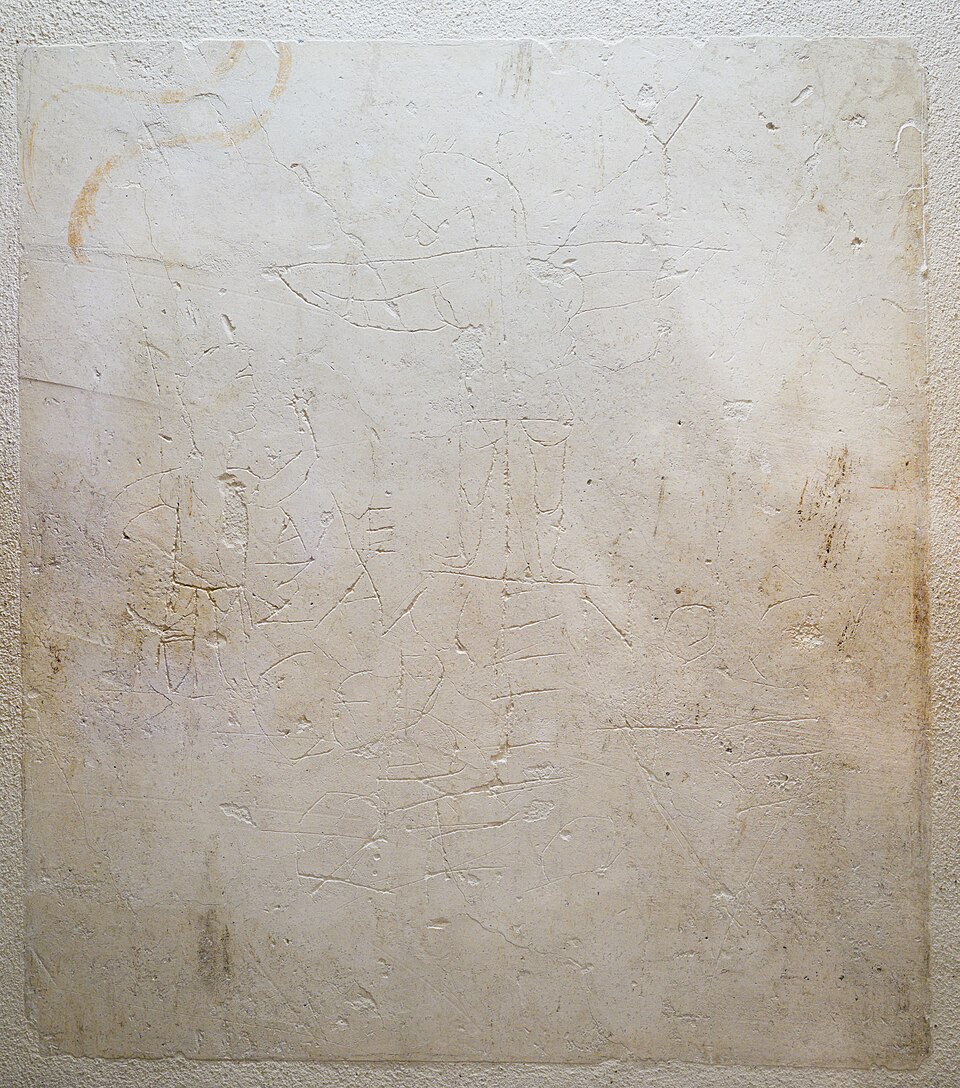
The Alexamenos graffito from Rome’s Palatine supplies a different kind of evidence. The official archaeological catalogue dates it to the late second or early third century. A scratched crucified figure with a donkey’s head appears beside a worshipper; it is commonly understood as mockery of a Christian named Alexamenos. Its date and interpretation should retain those limits. The image is not a portrait of Jesus or proof that Alexamenos was a soldier.
These witnesses rule out a claim that devotion to Jesus first appeared under Constantine in the fourth century. They do not establish that the later Nicene formulation already existed in every early community. Nor can they rule out every proposal about development within first-century Christianity. Philippians 2:6–11 is earlier literary evidence: it describes Christ in the form of God, speaks of equality with God, and moves through self-humbling and death to universal homage, explicitly directed to the Father’s glory. Christians reasonably treat that as a positive textual basis for divine identity. How its language relates Jesus to the Father still needs interpretation; the text should neither be flattened into ordinary respect for a teacher nor treated as a ready-made later creed.
Philippians 2:6, 11 (World English Bible Classic) speaks of Christ “existing in the form of God” and confesses “Jesus Christ is Lord, to the glory of God the Father”. The divine language and the distinction from the Father both belong to the passage under interpretation.
Jewish devotion to one God makes this development historically important. But Jewish life was diverse, and the evidence does not let us diagnose the minds of thousands of believers. Resurrection is the Christian explanation to assess, not the only logically possible cause of religious change. Claims that everyone instantly abandoned Sabbath observance, or that early worship itself proves divinity, add more than these sources establish.
Weak witnesses cannot do strong work
The Babylonian Talmud’s Sanhedrin 43a includes a passage about Yeshu, execution and accusations of sorcery and leading Israel astray. It comes through a much later rabbinic compilation, with difficult questions about the passage’s formation, identification and relation to Christian traditions. It is not a first-century courtroom record. An accusation of sorcery is evidence of an accusation; it is not independent confirmation that supernatural acts occurred.
Lucian’s second-century satire The Death of Peregrinus, sections 11–13, likewise refers to Christians and a crucified figure they revere. It contributes to the history of outside perceptions, not an eyewitness account of Jesus. Neither text warrants saying that all Jesus’ opponents conceded his miracles or that secular history knows nothing except a divine Jesus.
A choice between God, liar and madman is also too narrow when applied to these reports. It assumes we have already established precisely what Jesus claimed and rules out mistaken interpretation or later development before investigating them. Christians can make a more serious case by defending the testimony and Jesus’ identity directly, instead of treating incomplete alternatives as proof.
Read the Qur’an and its interpretations separately
Islam honors Jesus as Messiah and God’s messenger, while rejecting the Christian understanding of his divinity (Qur’an 4:171). Qur’an 4:157 denies that the people whose boast it reports killed or crucified Jesus; 4:158 says God raised him to himself. It does not name Judas, Simon of Cyrene or another substitute. Ibn Kathir’s commentary supplies a narrative of a volunteer being made to resemble Jesus. A commentary’s detailed explanation must not be passed off as wording found in the Qur’an.
Qur’an 4:157–158, in Mustafa Khattab’s The Clear Quran: “neither killed nor crucified him” and “Allah raised him up to Himself”. These excerpts contain the denial and raising; they do not identify a substitute.
The mainstream denial of Jesus’ death on the cross is represented in the Muslim explanation linked here. Ahmadi Muslims instead maintain that Jesus was placed on the cross but survived and later died naturally. That is a distinct minority interpretation, not the ordinary Sunni or Shi‘i account. Such diversity means that criticism must identify whether it challenges the verse’s wording, a particular interpretation, or a historical claim.
The strongest Muslim reply is that genuine revelation could correct even widespread early belief. Nothing about the calendar alone refutes that possibility. But this moves the argument to the credentials of the revelation. If the question is which account has better historical support without assuming either scripture’s authority, a later assertion of correction cannot supply its own verification. A Muslim may defend those credentials elsewhere; this historical comparison does not by itself settle the Qur’an’s claimed divine authority. Nor does this article decide the full case for resurrection or biblical inspiration.
An appearance or substitution explanation could account for why observers believed Jesus had been executed. Its capacity to fit the reports does not by itself give us positive evidence that a substitution occurred. Conversely, a Christian who invokes God’s action in resurrection also owes an argument beyond the observation that miracles are possible. Applying one evidential standard to both prevents the comparison from becoming a contest of assumed authorities.

Quran.com — explanation of 4:157 · Tahir Ijaz — Death of Hazrat Jesus, Al Islam
A historical foundation for examining the Christian claim
The conclusion is deliberately specific. Death by crucifixion has a strong historical basis; resurrection belief and extraordinary devotion to Jesus are early, not inventions first introduced by a fourth-century emperor. The proposition that God actually raised Jesus remains a further explanatory claim. Calling Jesus divine requires still more attention to his identity and the meaning of the Christian texts. Even resurrection would not, by itself, make any raised person God.
This gives a Muslim reader a concrete reason to reconsider dismissing the New Testament before hearing it. The mainstream denial of Jesus’ death on the cross must answer earlier evidence, while the Christian claim begins from an event that the early sources already place at the center. Paul’s account offers a positive explanation: Jesus died for sins, and resurrection grounds hope beyond death. Its value is not exhausted by finding a weakness in an Islamic argument.
Read 1 Corinthians 15 beside Mark 15 and 16:1–8, asking how well the resurrection explanation accounts for the testimony and how it relates to Jesus’ teaching and identity. The companion discussions of the Gospels and divine sonship can develop those questions. Historical inquiry does not force a confession of faith, but it gives good reason to examine Christianity’s central claim on its own evidence rather than presume that a later correction has already settled it.