


Affirmation and authority are different claims
The Quran affirms earlier revelation and appeals to scripture available to earlier communities. It also criticizes their handling of revelation and assigns itself a supervisory role. Together these statements give reasons to investigate particular biblical texts rather than dismiss the Bible as wholly unusable. They do not establish the stronger claim that the Quran endorses the complete wording, contents and theology of every present Bible.
Samuel Green's source essay argues for the reliability of Jewish and Christian scripture and for taking the Quran's claims about it seriously. Its inquiry is valuable, but confirmation does not by itself mean unconditional approval of everything now bound between a Bible's covers. To see what follows, we must distinguish the Quran's words, Muslim interpretations of them, surviving biblical witnesses and the further reasons needed to establish divine authority.
Tawrat is the Quran's term for Torah; Injil is its term for the Gospel given to Jesus. Christians use Gospel both for the good news and for narratives such as Matthew and John. Their New Testament also includes letters and other writings. These overlapping terms must not be treated as automatic synonyms for an identical collection. The Quran addresses the Jewish and Christian communities as the People of the Book.
The reason for investigating is specific: an appeal to earlier scripture can be tested only by identifying the teaching to which it appeals. A particular passage can be relevant evidence without every book or doctrine in its collection having been accepted. The task is therefore to examine the proposed connection and its limits, rather than choose between complete biblical certification and complete dismissal before reading.
Read 5:43–48 without stopping halfway
The clearest place to see both the appeal and its limit is Quran 5:43–48. The sequence begins with judgment: 5:43 challenges people who seek Muhammad's decision despite having the Torah with God's judgment in it. Verse 44 recalls the Torah's revealed guidance and those entrusted with it. Verse 45 names a rule of proportionate retaliation. Verses 46–47 introduce Jesus and the Gospel, then relate judgment to what God revealed there. These concrete references resist a claim that earlier scripture was simply unavailable or devoid of divine teaching.
Verse 48 then changes the focus to the revelation given to Muhammad. It presents the Quran as confirming earlier scripture and as muhaymin over it. Al-Tabari's commentary collects explanations involving trustworthiness, witness and guardianship, including judgment over earlier books. Ibn Kathir makes the criterion explicit: conformity with the Quran determines acceptance of earlier material. On this reading, confirmation and correction can coexist: acknowledging earlier revelation does not require accepting every surviving claim made in its name.
The verse also recognizes distinct laws and ways: God could have made one community, but instead tests people through what they have received. It calls for competing in good works and reserves final resolution of differences to God. Green takes this as proof of permanently parallel revelations. That conclusion is too strong: the same verse directs Muhammad to judge by the revelation given to him. Acknowledging different divine laws does not by itself settle their continuing legal authority.
Ibn Kathir's commentary on 5:47 offers two approaches: judgment by the Gospel in its own dispensation, or obedience to it understood to include accepting Muhammad. These readings challenge an argument that the verse commands Christians to retain all present Christian beliefs unchanged. They do not erase the positive references. The justified conclusion is that the passage recognizes earlier revelation and its authority in a qualified relationship to the Quran; it is not a certificate for a modern biblical canon. That qualification limits the scope of confirmation; it does not answer in advance what a particular earlier passage says or how well a proposed appeal to it works.
Confirmation is joined to another claim in Quran 10:37: explanation of scripture. Green reads this as the Quran explaining earlier revelation more fully. Ibn Kathir explains this in terms of rules and lawful and unlawful matters, alongside correction of earlier alterations. The verse therefore cannot simply be used as a promise that the Quran repeats or approves every biblical statement. Its explanatory claim needs to be specified before it can be tested.
Why appeals to existing scripture still matter
Other appeals make the proposed investigation more concrete. Quran 2:89 describes confirmation of what its audience has. Quran 5:68 tells the People of the Book to uphold Torah, Gospel and revelation from their Lord. Quran 3:93 calls for the Torah to be brought and read in a dispute about food. These references make it difficult to interpret every positive statement as referring only to a vanished book with no accessible content.
Quran 2:44 rebukes people who urge righteousness while neglecting their own conduct despite reading scripture. Quran 5:77 condemns religious excess beyond truth. Quran 53:36 appeals to the scriptures of Moses. The cumulative picture includes teaching, moral responsibility and sources that can be invoked in argument. But a useful source need not be wholly intact for a particular appeal to work; this is the limit Green's broader inference must acknowledge.
Quran 10:94 directs the addressee, if in doubt, to those who read earlier scripture. The conditional wording does not establish that Muhammad actually doubted or consulted them. Quran 7:157 says the messenger is described in Torah and Gospel with their communities; 20:133 and 26:196–197 also appeal to earlier scriptural testimony and learned recognition. These are claims of continuity and corroboration that merit investigation, not completed demonstrations of their own truth.
An informed Muslim reply is that genuine remnants can confirm Muhammad, with the Quran separating those remnants from error. That is logically compatible with selective confirmation. A Christian counterquestion asks how a proposed prophecy is identified in its original context, and what independently supports the Quran's authority to judge it. The Muslim may ground that authority in a wider case for revelation. These verses alone do not decide that wider debate. Both sides should expose the steps connecting a text to the claimed conclusion. Selective confirmation therefore answers the demand for whole-Bible approval, but it still leaves specific interpretations open to examination. The dispute over the final judge must not be confused with the prior task of identifying what each text actually claims. If agreement with the Quran is the sole reason for accepting the selected biblical material, using that same selection as independent proof of the Quran's authority would assume what it is meant to establish. A separately supported case for revelation would be a different argument.
Belief in earlier revelation and responsibility for it
These appeals belong within a broader account of revelation. Quran 42:13 places Noah, Abraham, Moses, Jesus and Muhammad within a continuing divine purpose. In 29:46, the required response to the People of the Book includes acknowledgment of revelation given to them and of one God. In 4:136, rejection of God's books belongs among serious failures of faith. Earlier revelation is therefore part of the Quran's account of Islam, rather than an exception to it.
Quran 3:84 says believers make no distinction among the named recipients of revelation. This requires their acknowledgment; it does not state that all communities' current teachings or laws are interchangeable. Indeed, the next verse, 3:85, insists on Islam. Reading both verses prevents a declaration of faith in the prophets from becoming a claim that all religious positions are equally endorsed.
Custody also creates responsibility. Quran 5:44 describes learned custodians of the Torah, and 3:187 condemns failing to make scripture known, hiding it and exchanging that duty for gain. Quran 2:140 likewise condemns concealed divine testimony. The point is not merely possession of a sacred object: people are accountable for what they disclose, teach and do. These accusations assume a distinction between God's revelation and human misuse of it.
People are not all alike
Responsibility for scripture leads to another distinction: the Quran does not judge all its custodians alike. Quran 3:113–115 describes an upright group among the People of the Book, characterized by worship, faith and good deeds. Quran 5:82 associates Christian friendliness with priests, monks and humility. But 5:83–85 continues with people responding in faith to the messenger's revelation. These are contextual descriptions, not a survey of every Jew or Christian in any century.
There is also an important interpretive qualification. Ibn Kathir's commentary on 3:113 identifies the praised people with members of earlier communities who embraced Islam. Consequently, one cannot simply use this passage to prove that the Quran approves every doctrine held by Christians who do not accept Muhammad. Nor does moral praise prove a particular manuscript's complete preservation. Good character and textual transmission are related human concerns, but they are not the same evidence.
Distortion, concealment and false attribution
A judgment about people does not yet tell us what happened to a text. A claim that scripture was corrupted therefore needs a defined meaning. Textual alteration changes wording. Interpretive distortion assigns a misleading meaning to wording that may remain intact. Concealment prevents others from seeing what is there. False attribution presents something human as revelation. A single accusation of corruption can hide these different claims, making a fair test impossible.
Quran 3:78 describes people manipulating their speech so that hearers mistake it for scripture. Quran 2:78–79 moves from ignorance of scripture to people writing something and falsely presenting it as divine for gain. The second accusation cannot honestly be reduced to nothing but interpretation. Yet neither passage identifies every manuscript everywhere or demonstrates that all surviving biblical content was replaced.
Quran 5:13 speaks of displacing words and neglecting part of what was enjoined; 5:14 accuses Christians of neglected obligation; 5:15 describes the messenger exposing concealed material. The source also quotes 2:59, but its context is changing the words people were commanded to say when entering a town, not a description of rewriting the complete Bible. Different acts require different evidence.
Muslim commentary itself should be read beyond a useful quotation. At 3:78, Ibn Kathir reports a preservation statement attributed to Wahb ibn Munabbih, then rejects its application to the books currently held by the People of the Book and alleges additions and deletions. It would misrepresent the commentary to quote only the preservation statement. Conversely, the commentator's allegation is not a manuscript comparison establishing every claimed change. A historical investigation must still identify witnesses and readings.
Abrogation is not the same as falsification
A different question concerns the authority of a law, even when its wording survives. Abrogation means that a rule's binding force is replaced or ended. That can be claimed even when the text preserving the earlier rule remains accurately copied. Thus saying that a later revelation supersedes earlier legislation is not the same as saying scribes falsified the earlier book. The source's argument sometimes treats continued usefulness of scripture as if it ruled out supersession; that step does not follow.
Green cites Quran 2:106, which describes an abrogated or forgotten revelation being replaced by something better or similar, together with a report about Ubayy in Sahih al-Bukhari. The report is identifiable as Bukhari 5005, Book 66, report 27 in Sunnah.com's numbering; its older reference is volume 6, book 61, number 527. In the report narrated by Ibn Abbas, Umar explains leaving out some of Ubayy's recitation by appealing to 2:106. Ubayy, by contrast, insists on retaining what he learned from Muhammad. The contrast explains why the report is relevant: it applies the abrogation principle to Quranic recitation.
Quran 16:101 adds another example. It describes one verse replacing another and opponents responding by accusing Muhammad of fabrication. Green uses that setting to argue that the replacement concerns Quranic revelation. These examples support application of abrogation within the Quran; they do not establish that Muslim thought excludes supersession of earlier religious laws.
The nearby challenge in 2:111 to produce proof also cannot settle that issue: an earlier source can supply evidence even when its law is no longer binding. Green also invokes the later acknowledgment of revelation in 2:136. Its proximity to 2:106 shows that acknowledgment and abrogation are discussed within the same chapter; it does not prove that every earlier rule remains binding. Moreover, 2:111 does not expressly say to bring a biblical manuscript; 3:93 does explicitly ask for the Torah. The distinction matters. Ibn Kathir at 5:46–47 even describes the Gospel as changing some Torah rulings while confirming it. Confirmation and legal change are therefore not necessarily opposites within this interpretive framework.
Which books, and what can historical witnesses establish?
These distinctions still leave the question of which books and witnesses we can examine. Jewish scripture includes Torah, Prophets and other writings; Christians receive these writings within the Old Testament. Christian biblical collections are not uniform in every book, as the inclusion of Tobit in Catholic Catechism 120 and its absence from the Westminster Confession 1.2 list illustrate. The four Gospel narratives are not identical to the whole New Testament. The existence of overlap does not authorize replacing every Quranic occurrence of Torah or Injil with the phrase the entire modern Bible.
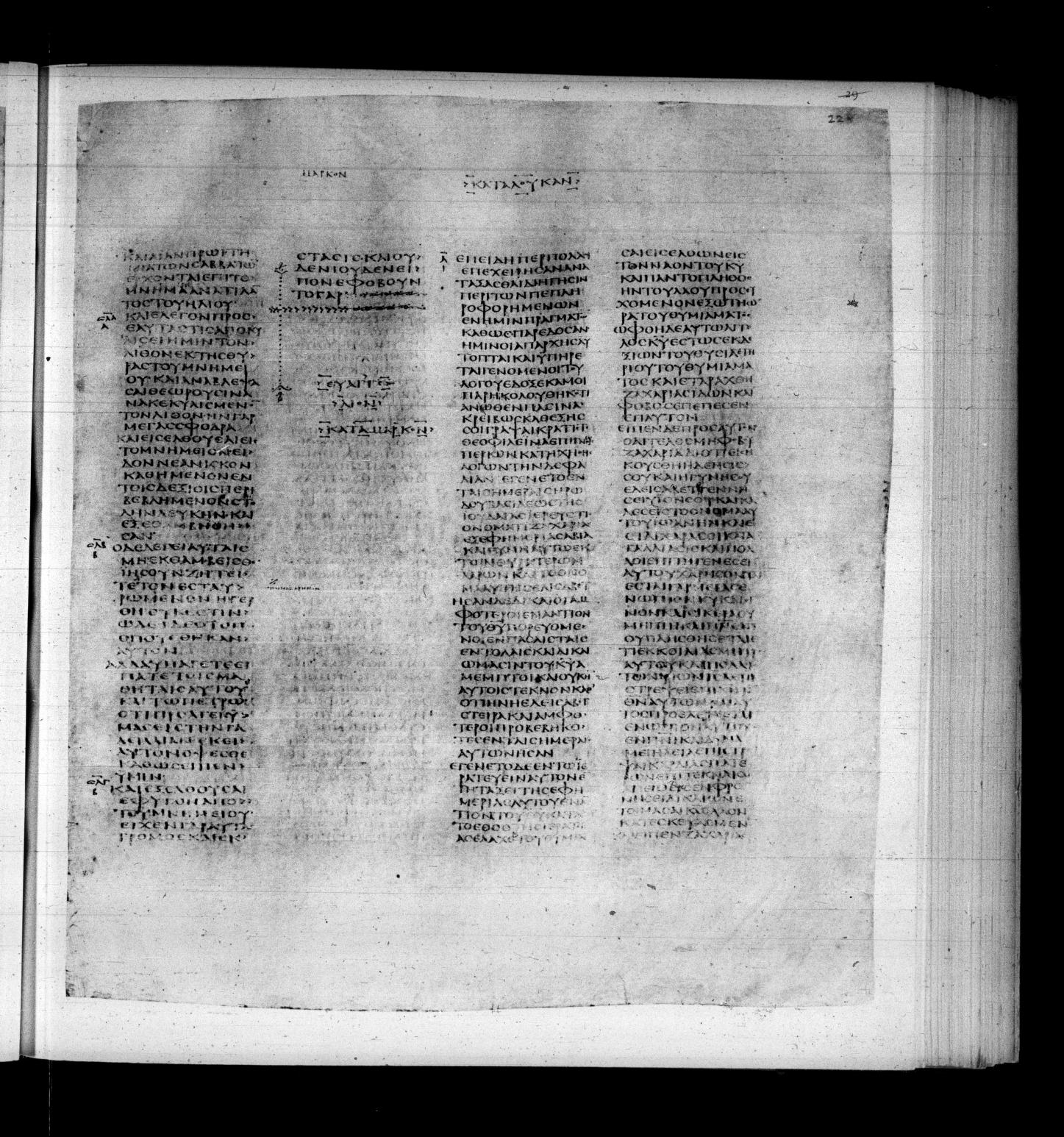
Historical witnesses nevertheless prevent the discussion from becoming purely hypothetical. Harry Gamble's Smithsonian account identifies Codex Sinaiticus as a fourth-century Greek biblical manuscript whose New Testament survives complete. Its contents also include the Epistle of Barnabas and part of the Shepherd of Hermas, and it contains numerous corrections. This gives a substantial pre-Islamic witness to Christian texts while warning against claims of identical wording or identical canonical boundaries across all copies.
An earlier manuscript establishes that a text or reading existed by that witness's date. It does not establish that the text was written by God, that every reported event happened, or that every earlier stage was unchanged. A Muslim can therefore question Christian claims while accepting the manuscript's antiquity. Equally, a claim that familiar Christian writings were all invented after Islam must confront actual earlier witnesses. Specific passages can be compared instead of treating the Bible as an undefined object.
Does John’s Comforter identify Muhammad?
When an appeal concerns prophecy, identifying the text also lets us test the proposed reading. Green also cites the biography of Muhammad compiled by Ibn Ishaq, in Alfred Guillaume's The Life of Muhammad, pages 103–104. The passage expressly introduces material from John's Gospel and uses the promised Comforter in an argument about Muhammad. This verifies an early Muslim use of identifiable Johannine material; it does not certify the entire New Testament. Guillaume's accompanying note points to a Syriac textual setting and difficulties in the transmitted wording. The passage is evidence of reception and interpretation, not an exact transcript of an original revelation given to Jesus.
The context in John matters independently. John 14:26 identifies the Comforter with the Holy Spirit, and 15:26–27 connects the Spirit's testimony with that of the disciples. Quoting Ibn Ishaq establishes that the identification with Muhammad was made, not that it is linguistically or historically correct. Taken as an interpretation of the received passage, the identification fails to account for its explicit identity and audience. The citation therefore does not establish this proposed biblical support for Muhammad's prophethood.
IslamQA answer 10116 acknowledges John 14:26 but argues that later coming, additional teaching, speaking what is heard and continued presence through Muhammad's teachings better fit him. The comparison is an argument from the text, so it cannot be dismissed merely as circular. It must, however, also explain John 14:17, where Jesus says his hearers already know the Spirit, and 14:26, where the promised teacher reminds them of Jesus' own instruction. A teaching enduring for later generations does not by itself explain those statements to the present disciples.
John 16:7 does place the Comforter's coming after Jesus' departure. Within the same narrative, John 7:37–39 already links receiving the Spirit with Jesus' glorification. Earlier presence and a later mission are therefore not mutually exclusive within John's account. These contextual links support the Christian reading of the named Spirit more directly than identifying a later human messenger. This is a judgment about the received narrative, not a claim that a comparison of all early manuscripts has been completed.
A Muslim may instead allege altered wording or defend the Quran as a separately warranted divine correction. That remains a question for evidence; later chronology alone cannot decide it. If contrary wording is set aside solely because Quranic authority is assumed, however, the resulting biblical selection cannot independently prove that authority. This precise limitation matters to someone deciding whether the claimed biblical corroboration is a sound foundation for belief in Muhammad. It does not establish that every possible prophecy claim is false: Quran 7:157 does not identify John's passage, and a wider case for revelation must be assessed separately.
A positive biblical comparison
The method becomes useful when we follow one identifiable connection instead of judging an entire canon at once. Quran 5:45 names the Torah's rule of proportionate retaliation. Leviticus 24:17–22 sets out corresponding rules for death, injury and restitution; verse 22 requires the same law for a foreigner and a native. This is a recognizable correspondence between the Quran's account and a biblical text. It supports taking that text seriously as a relevant witness, though it is not an exact quotation of the whole passage or proof of every biblical claim.
Matthew 5:38–48 provides a specifically Christian continuation. Matthew frames the teaching with Jesus' statement that he fulfills the Law and Prophets (5:17). Jesus cites the retaliation formula, gives examples of refusing retaliation and acting generously, then commands love for enemies. He appeals to God's provision for both the just and unjust. Read within Matthew's account, this is an explanation of what following Jesus entails and why; it is not merely an isolated moral slogan. Matthew is relevant here because it presents Jesus' relationship to the earlier law as a claim we can examine. Whether that account rightly explains fulfillment is now a concrete question about a text and its reasons, rather than a verdict based only on the label Christian.
The reason Jesus gives makes the Christian claim more than an attractive injunction. Matthew 5:45 presents God as Father whose sun and rain benefit evil and good people, the just and the unjust. Love restricted to those who repay it would not reflect that generosity. The teaching thus connects the life Jesus calls for with a particular understanding of God's character. That coherence is a positive reason to consider Jesus' account of the Father; it is not independent proof that the account is inspired or that every reported event occurred.
The comparison should not be turned into a crude contrast between a harsh Torah and a merciful Gospel. Leviticus limits the response by the injury and requires equal treatment; Quran 5:45 itself commends foregoing retaliation. Nor does the comparison settle every Christian debate about courts, self-defense or the relation of Gospel and law. It does show why hearing the biblical passages in context is more informative than judging them from a label such as corrupted.
The original essay ends by asking whether the Quran fulfills its claims to confirm earlier revelation, find prophetic support there and clarify its teaching. A fair test first specifies the claim: agreement about which teaching, a prediction in which passage, or clarification of which question? For a proposed clarification, identify the difficulty and show what the explanation resolves rather than citing later authority alone. Read the earlier text in context and compare relevant witnesses before accepting either a proposed fulfillment or an allegation of corruption. A supported correspondence can favor a particular claim; a demonstrable failure can count against it. Neither result should be announced from a mistranslation, a disputed premise treated as certain, or a requirement the Quran never actually makes. The same scrutiny applies to Christian claims of biblical fulfillment.
Neither a flaw in an anti-biblical argument nor one favorable Quranic reference makes Christian faith an automatic conclusion. The wider disagreement about revelation remains, and the preceding argument is not an Islamic legal ruling about who should read other scriptures. Its more limited conclusion is that the Quran's own appeals, surviving witnesses and intelligible correspondences give reasons and material for investigating particular biblical texts.
The Comforter identification does not establish the claimed biblical corroboration of Muhammad; its received context points to the Spirit known to Jesus' disciples. If agreement with the Quran is the sole reason for accepting selected biblical material, that selection cannot independently establish the Quran's authority. These findings give a reason to reassess that supporting argument for Islam and to hear the Christian witness without first submitting it to an authority this argument has not proved. Matthew's portrayal of the Father and of Jesus' fulfillment then offers a positive account to consider on its own evidence. What the passage means, how it was transmitted and why its claim should be believed remain distinct questions, tested by the same standards for both traditions.
Quran 7:157 · John 14:16–18, King James Version · Quran 5:48; Ibn Kathir, abridged English tafsir