


The difference begins with a claim of authority
The Qur’an’s biblical stories are not presented as translations of Jewish and Christian books. They belong to a proclamation that claims to confirm earlier revelation and settle disputed truth. Qur’an 5:48 describes the book as confirming preceding Scripture and as muhaymin over it, variously translated with ideas of oversight, guardianship or authority. Ibn Kathir’s commentary explicitly treats it as a judge over earlier books.
Qur’an 5:48 describes the book as “a supreme authority on them” (Mustafa Khattab, The Clear Quran). This wording expresses the authority claim being examined.
This explains why Muslims need not find a different account embarrassing: if the Qur’an is divine revelation, its correction can be true even when it is later. The question for someone who has not accepted that premise is how the correcting authority is established. A text’s assertion of authority identifies the claim to investigate; it cannot, by itself, decide the investigation.
We will compare two cases with different evidential strengths: Mary’s relationship to Aaron, and Jesus making clay birds alive. The first cautions against a quick charge of error. The second has a demonstrably earlier literary witness. Together they show why a blanket verdict of either perfect correction or proven plagiarism avoids the harder work.
Mary, Miriam, and the force of a family title
Qur’an 19:27–30 places the address to Mary in a confrontation. She arrives with her child; the people contrast her apparent conduct with her parents’ good character, call her Aaron’s sister, and object when she points them toward the infant. The title contributes to an accusation about family honor, not an explicit date for her life.
The comparison with Exodus 15:20 is nevertheless striking. There Miriam is called Aaron’s sister in the Moses narrative. Qur’an 66:12 also names Mary as the daughter of Imran. Those associations reasonably prompt a reader to ask whether older figures have been brought together. They do not themselves tell us whether the association is literal genealogy, inherited naming, figurative affiliation, or literary patterning.
Compare “O sister of Aaron!” in Qur’an 19:28 (Khattab) with “Miriam the prophetess, the sister of Aaron” in Exodus 15:20 (World English Bible). The surrounding narratives identify the two settings; the shared title is what needs explanation.
Sahih Muslim 2135 reports Christians at Najran raising the time gap between Moses and Jesus. In the report, al-Mughira takes their question to Muhammad, who answers by referring to the practice of naming people after earlier prophets and righteous persons. This is evidence of a Muslim answer to the objection. It is not an independent first-century record of Mary’s household, and it does not expressly say that she was descended from Aaron or name her contemporary brother.
The reported reply in Sahih Muslim 2135 refers to “Apostles and pious persons who had gone before them” (Sunnah.com English edition). It explains a naming practice, rather than supplying an independent record of Mary’s family.
Ibn Kathir’s commentary offers more than one explanation: resemblance to Aaron in worship, descent expressed through kinship language, or association with a righteous man called Aaron. These are interpretive alternatives, not cumulative discoveries of Mary’s family tree. Luke 1:5 calls Elizabeth a descendant of Aaron, and 1:36 calls her Mary’s relative; that supplies relevant biblical background, but does not by itself establish Mary’s exact paternal ancestry.
Modern scholarship also considers deliberate literary association. In the published abstract of her 2021 study, Nesya Rubinstein-Shemer argues that the two figures overlap intentionally through biblical and rabbinic literary practices. That is a scholarly proposal, not a consensus or a demonstrated genealogy; it further cautions against treating resemblance alone as proof of ignorance.
The responsible conclusion is limited. The overlap deserves explanation, and the later explanations do not independently verify a genealogy. But the text and its interpretive history leave enough alternatives that this title alone cannot prove confusion about chronology. One need not accept the Qur’an as revelation to reject an overconfident argument against it.

A miracle shared with a noncanonical Gospel
Qur’an 3:49 says that Jesus will form something bird-like from clay, breathe into it, and it will become a bird by God’s permission. Qur’an 5:110 recalls the same act as a favor God granted him. Neither verse itself gives Jesus’ age at the event. The repeated permission language places the miracle within the Qur’an’s account of a messenger empowered by God.
Compare chapter 2 of the First Greek Form of the Infancy Gospel of Thomas in the Alexander Walker translation. Five-year-old Jesus shapes twelve sparrows from clay on the Sabbath. After a complaint and Joseph’s intervention, Jesus claps, commands the birds, and they fly away. The shared sequence—Jesus, clay, birds, animation—is specific enough to deserve historical comparison. The differences in action, setting and purpose matter too.
In Qur’an 3:49, the result is “a ˹real˺ bird—by Allah’s Will” (Khattab). In the Infancy Gospel of Thomas, First Greek Form, chapter 2, “And the sparrows flew, and went off crying.” (Alexander Walker, 1886). These are the respective narrative claims, not independent proof that the miracle occurred.
This writing is not one of the New Testament’s four Gospels. Calling it noncanonical identifies its place outside that collection; it does not automatically prove that every event it narrates is invented. Conversely, calling it a Gospel does not establish an eyewitness author. Nor should it be confused with the separate sayings collection commonly called the Gospel of Thomas.
The comparison shows that the Quranic account belongs in an investigation of Christian traditions beyond the biblical canon. It does not show that Muhammad had this particular Greek text before him, that he had no access to any biblical material, or that he mistook one kind of Christian writing for another. Those are further claims requiring further evidence.
What the papyrus adds—and what it cannot add
A particularly useful witness is P.Hamb.Graec.1011, held in Hamburg. Lajos Berkes and Gabriel Nocchi Macedo published it in 2024 in Zeitschrift für Papyrologie und Epigraphik 229, pages 68–74. They assign its handwriting to the fourth or fifth century. Paleography compares handwriting; it provides an argued date range, not an exact year or a radiocarbon result.
The damaged fragment preserves part of the clay-bird episode and its continuation. It is not a complete copy of the later Greek version summarized above. The work’s commonly proposed second-century composition date and this fragment’s fourth–fifth-century date answer different questions: when a work originated, and when a surviving copy was written. The editors announced an adjoining fragment in 2025. The photograph used here shows the original fragment, not the combined witness.
This is strong evidence that the episode circulated before the Qur’an. It is not evidence that this particular sheet traveled to Arabia. A written source can preserve a story that also circulated orally; a surviving manuscript need not be the transmitter’s actual source. The precise route by which related material reached the Quranic setting remains unestablished by this find.
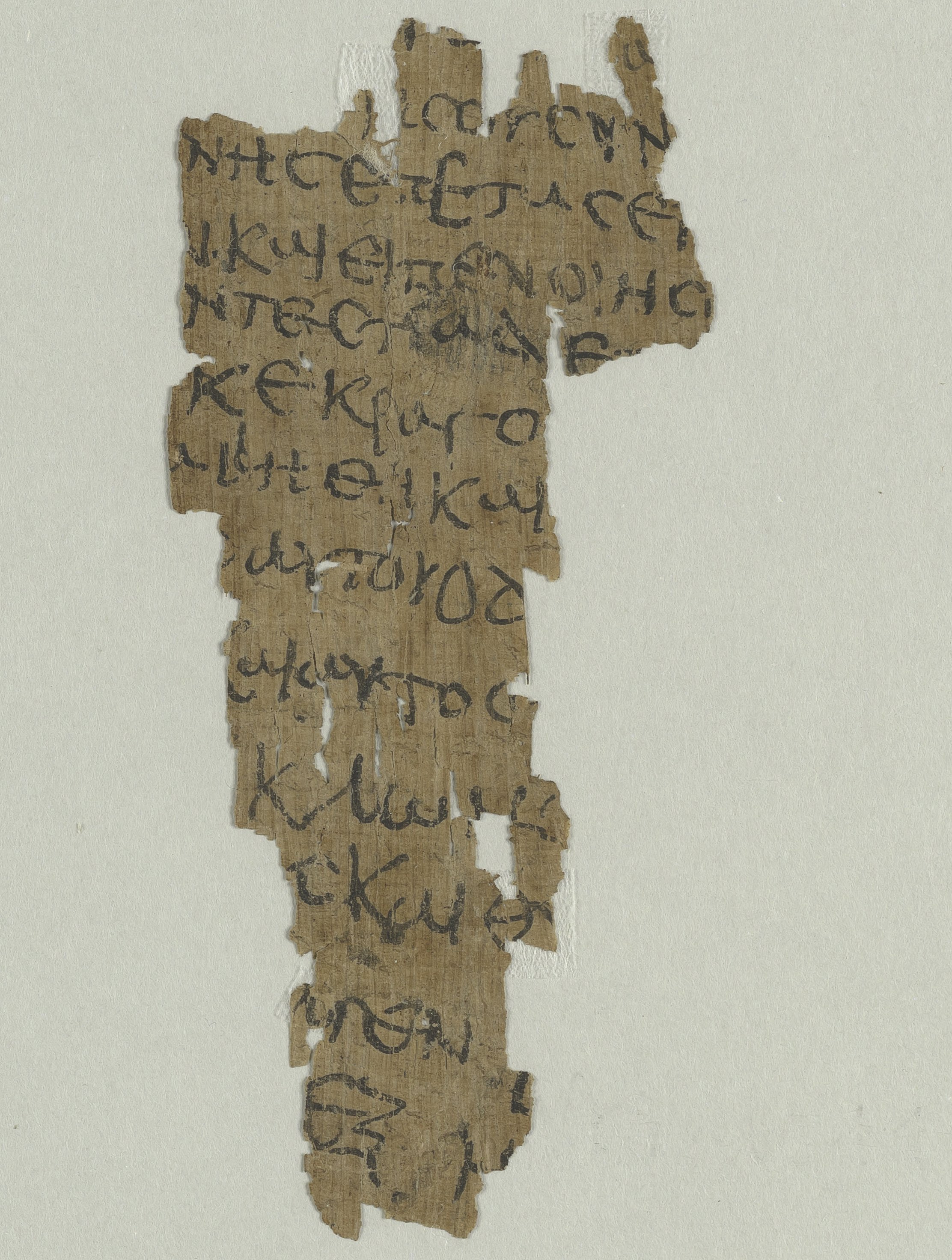
Humboldt University (2024), announcement of the papyrus identification
The strongest Muslim explanation
The strongest theological reply is straightforward: God can reveal a true event that an earlier community also remembered. On that view, similarity is expected because the prophets share one divine source, while differences correct or refocus the earlier telling. Qur’an 5:48 supplies the framework; the insistence on God’s permission in the bird passages fits it.
That answer is coherent within belief in Quranic revelation. The earlier parallel does not logically disprove it. A historian, however, can establish the existence and relation of texts without thereby establishing that one is God’s correction of the other. To use divine correction as evidence for the Qur’an’s authority while assuming that authority to explain every difference would reason in a circle.
A Muslim could respond that belief rests on other arguments for Muhammad’s prophethood or for the Qur’an, not on this story alone. That is a serious counterreply: those arguments must be examined on their own merits. These two comparisons do not refute every possible case for Islam. They do show why the presence of familiar biblical figures is insufficient to make the Qur’an an independently verified account of their lives.
Ibn Kathir on Qur’an 5:48–50 · Qur’an 5:110 — the miracle recalled
A shared tradition is not a psychological diagnosis
Several conclusions must be kept separate. An earlier witness establishes that a story existed earlier. A close parallel supports investigating shared traditions or a literary relationship. Direct dependence on an identified source requires a stronger argument about access and distinctive connections. Conscious deception requires evidence about intention. None of the later conclusions follows automatically from the earlier one.
This also rules out unsupported percentages of Quranic borrowing. There is no defined sample, agreed unit of measurement or demonstrated calculation here from which to derive such figures. Calling the relationship plagiarism imports questions of authorship and concealment that a simple parallel cannot answer. The Qur’an openly claims continuity with earlier revelation.
We likewise cannot diagnose Muhammad with a memory disorder or reconstruct a transition from sincerity to manipulation from these passages. A person may be sincere and mistaken; a text may reuse traditions creatively; a believer may regard continuity as revelation. Identifying these possibilities is not choosing a psychological biography. Criticism of a truth claim is stronger when it does not pretend to know an author’s unrecorded thoughts.

Qur’an 5:48 — confirmation and oversight · Infancy Gospel of Thomas, First Greek Form, chapter 2 · Berkes and Nocchi Macedo (2024), P.Hamb.Graec.1011
The same standard must apply to Christian claims
A Christian argument would also fail if it said that an older account is always true, that embarrassing details cannot be invented, or that a story outside the canon must be false. Earlier testimony generally matters because it may be closer to people and events, but age is not a substitute for evaluating sources, genre and corroboration. These principles apply to the Gospels as well as to the Qur’an.
There is a concrete positive reason to investigate the canonical Gospels. Luke 1:1–4 presents a writer working with earlier accounts and traditions from eyewitnesses, seeking an orderly account. This gives readers a stated basis for historical inquiry, even though the preface is not an external certificate that every claim is accurate. John 20:30–31 openly explains the purpose of his selected signs: belief in Jesus as Messiah and Son of God, leading to life in his name.
Luke 1:2 refers to “those who from the beginning were eyewitnesses”; John 20:31 identifies the belief sought: “Jesus is the Christ, the Son of God” (World English Bible). The first passage states the claimed relation to testimony; the second makes the Christian purpose explicit. Neither quotation independently verifies its author’s claims.
John’s Christian conclusion and the Qur’an’s emphasis on Jesus as God’s empowered messenger need to be understood in their own contexts. A list of shared miracles cannot erase the difference or decide which portrait is warranted. The Gospels deserve to be heard as sources for the Christian claim, rather than being judged only through the authority of a later book whose right to correct them is precisely the issue.
What should guide the next comparison?
Read the actual passages before accepting a verdict about them. For Mary, compare Qur’an 19:27–30 with Exodus 15:20, then read the naming explanation in Muslim 2135. For the birds, compare Qur’an 3:49 and 5:110 with Infancy Gospel of Thomas 2, keeping the early papyrus distinct from the fuller later textual form.
The results are neither a blanket acquittal nor a blanket charge. One alleged error has serious interpretive alternatives; one narrative parallel has concrete pre-Islamic attestation. Neither establishes Quranic correction as divine or borrowing as dishonest. The next question is therefore a question of warranted authority: what gives us reason to trust the Qur’an’s account of Jesus over the Christian testimony it reinterprets?
Luke’s account of investigated testimony and John’s stated purpose provide a practical starting point for examining the Christian answer. Let those texts make their case before assuming that disagreement with the Qur’an disqualifies them. That is a reasoned step toward evaluating the God and Jesus proclaimed by Christianity, not a claim that two parallels have already proved the whole Christian faith.
Luke 1:1–5, 26–38 — sources, Mary and Elizabeth · John 20:30–31 — why the signs were written