


What does collection prove?
The Qur’an’s collection history raises a precise question: does a record of people preserving a text show that they succeeded, failed, or acted under divine protection? The received reports describe a deliberate process of collection and standardization. A Muslim can understand that human care as the means of divine preservation. Describing the process alone neither refutes that belief nor proves its divine cause or the text’s completeness. A precaution against loss is not evidence that loss already occurred; nor does a standard copy, by itself, prove that nothing was ever omitted. John Gilchrist’s chapter makes collection a historical question worth examining. We will follow its strongest examples, distinguish what they say from what he infers, and use the result to frame a fair investigation of the Bible. When preservation is offered as grounds to accept the Qur’an’s divine authority while human transmission is used to reject the Bible, two inferences need testing. Neither inference is secured by collection history. Testing them removes a proposed barrier to assessing the Christian account of God and Jesus; it does not predetermine that assessment.
In Muslim belief, the Qur’an is revelation given to Muhammad; Qur’an 12:2 presents it as an Arabic recitation. A mushaf is a written copy of that scripture. Hadith are transmitted reports about Muhammad and the early community; commentary explains and interprets texts. A statement in a hadith about the collection of the Qur’an is therefore not itself a Qur’anic verse. These sources contribute different kinds of evidence. Here, memorization means retaining the text in memory, collection means assembling material, and standardization means establishing copies to be followed. Confusing those tasks makes a later collection look like the first existence of the text.
A report and an event are not the same thing
Our principal texts are Sahih al-Bukhari, Book 66, Virtues of the Qur’an, chapter 3, The collection of the Qur’an, reports 4986–4988 in Sunnah.com’s numbering. The collection is highly authoritative in Sunni Islam. Its compiler died in 870, long after the seventh-century events described. The reports present chains of transmission reaching earlier narrators; that is a claim to transmitted testimony, not a claim that al-Bukhari attended the events.
Recognizing this gap does not prove fabrication. It tells us what further work is needed: compare transmissions, investigate earlier evidence and ask whether manuscripts fit the narrative. Equally, a report’s accepted religious status does not make every modern inference from it part of the report. Throughout this discussion, “the report says” identifies the evidence we actually possess; “therefore this happened exactly so” would require an additional historical argument.
Sahih al-Bukhari 4986 · Sahih al-Bukhari 4987 · Sahih al-Bukhari 4988
Abu Bakr’s collection: what 4986 says
In 4986, Zayd ibn Thabit relates that Abu Bakr summoned him after deaths at Yamama. Umar feared that further deaths among reciters could lead to substantial loss and urged a collection. Abu Bakr and Zayd initially questioned doing something Muhammad had not done. Zayd eventually searched written materials, including palm stalks and thin stones in the displayed translation, alongside the memories of men. The resulting sheets remained with Abu Bakr, then Umar, then Umar’s daughter Hafsa.
The collection is best understood as the task the report actually describes. Knowing words, possessing written fragments and producing an assembled, checked copy are different achievements. A person may remember a text while a committee still needs to establish a documented copy; fragments do not assemble themselves because their words are familiar. The narrative therefore supports a collection after Muhammad, not the claim that the Qur’an first came into existence then.
This is why the difficulty of Zayd’s task cannot do all the work Gilchrist assigns to it. Gilchrist reasons that perfect memorization would have made collection easy. Yet responsibility, corroboration and concern about an unprecedented procedure could make the task demanding even with familiar material. These are possible explanations, not knowledge of Zayd’s private thoughts. More decisively, Umar expresses fear of future loss; the report does not say that verses had already disappeared at Yamama. Evidence of a danger and action against it cannot substitute for evidence that the feared outcome occurred. Trained human memory also differs from divinely guaranteed, errorless recall. Gilchrist attributes that stronger view to Desai, whose cited edition has not been independently checked here; we should not assign it to every Muslim. Cross-checking can be a means of preservation rather than an admission that preservation failed.
Finding a verse is not necessarily first learning it
The most troubling detail in 4986 comes at the end of Zayd’s search. He finds the closing verses of surah al-Tawba, identified on Sunnah.com as 9:128–129, with Abu Khuzayma al-Ansari and with nobody else. Gilchrist takes this to mean that only one companion knew them. That inference depends on what Zayd was seeking: any knowledge of the words, or a particular kind of testimony for the collection? Ammar Khatib and Nazir Khan defend the second reading, arguing that the search concerned written testimony to words also retained orally. They draw on other reports and later explanations, not just this sentence. The sentence alone does not count everyone who knew the passage.
Bukhari 4988 shows why the distinction matters. In the later copying operation under Uthman, Zayd remembers Muhammad reciting 33:23, searches for it, and finds it with Khuzayma ibn Thabit. Within that account, remembering and searching coexist. This defeats the general inference that a search must mean ignorance of the words; it does not prove every detail of the documentary explanation of 4986. The verses, episodes and named witnesses must not be conflated. Muslim scholars differ over how the names and timing should be reconciled; the narrower point does not depend on settling those reconstructions.
The result is a limit on both arguments. Bukhari 4986 alone establishes neither that only one person knew the closing verses nor that hundreds certainly knew them and the asserted documentary protocol is fully supported. A critic may ask for evidence of the checking rules. That request becomes a claim of communal failure only if further evidence supports it. A defender may explain the search as corroboration, while acknowledging what must be supplied from sources beyond Bukhari’s brief wording.
Gilchrist’s comparison of Ibn Hajar and later defenders raises a further, legitimate question: has a cautious interpretation become a claim of certainty? His chapter contrasts language of probability with a later assertion that hundreds certainly knew the verses. Neither confidence nor the number of times a claim is repeated supplies the missing evidence. But Ibn Hajar’s later date is not itself proof that he invented the interpretation; later commentary can transmit earlier material. The exact supporting accounts matter more than an accusation about the interpreter’s intentions. In Fath al-Bari 9:13, Ibn Hajar records an earlier explanation transmitted through Ibn al-Tin from al-Daudi: Zayd also knew the passage. Ibn Hajar questions reducing the transmission issue to two witnesses and favors understanding the search as a search for writing. This does not establish how many people knew the verses. It does show why citing Zayd’s shared knowledge cannot support a claim that nobody besides Abu Khuzayma knew them.
The chapter also cites a distinct narrative in Ibn Abi Dawud’s Kitab al-Masahif, found in the checked digital text at pages 112–113. It describes collection under Umar, his death, and a subsequent request for material by Uthman. Khuzayma draws attention to two unrecorded verses, Uthman attests them, and, after asking about placement, puts them at Bara’a’s close. The placement advice is therefore really in this transmitted account. Its setting does not automatically identify it with Bukhari’s Abu Bakr episode. Its historical reliability and relationship to the other reports still require assessment; the text’s existence alone establishes neither permanent loss nor a wholly improvised Qur’an.
Receiving a passage directly from Muhammad and possessing a document written in his presence are different claims. The additional report’s verb talaqqaytu describes receiving the passage, without itself specifying a written document; it does not say that no such document existed either. Yet supervised writing is not a purely modern explanation: Ibn Hajar discusses it among interpretations of the witnesses’ role in Fath al-Bari 9:12. The fair question is how those interpretations are supported, not whether they can be silently inserted into Bukhari’s shorter wording. One report he cites about the checking procedure is explicitly described as disconnected despite trustworthy transmitters.
The source ends this discussion with a useful hypothetical: would Zayd have included remembered verses without the required written witness? The reports examined do not state what he would have done in that hypothetical situation. That question exposes the need to establish the checking rule, but cannot prove that verses were actually excluded. Neither a defender’s reconstructed protocol nor a critic’s hypothetical should be presented as an observed outcome.
Before a collected volume: recitation, writing and order
To understand why collection did not begin with a blank page, we must now look back to Muhammad’s lifetime. Qur’an 25:32 answers an objection that revelation was not delivered all at once. The received picture is teaching given over time, not a completed volume handed over in a single moment. Bukhari 4982 also describes abundant revelation near Muhammad’s death. Continuing revelation helps explain a final collection after his death; it does not make earlier written collections impossible.
Gradual delivery does not imply disorder. Gilchrist moves too quickly from delivery in separate passages to an assertion that no thought was given to theme or arrangement. Received reports already recognize identifiable units: Sahih Muslim 808a mentions al-Baqarah’s closing verses, and 809a al-Kahf’s opening verses. Muslim 811a identifies surah 112 by its opening words. Failure to use a particular title in that report does not establish that the title was unknown. The order in which passages were delivered, the placement of verses within each surah, the order of surahs in a volume and the names of surahs are separate questions. A collection can follow an intentional order without following the chronology of revelation. Al-Suyuti preserves accounts of instructed verse placement but also records disagreement over whether surah order was prescribed or determined by companions. One final-order view should not be presented as universal agreement.
Recitation and writing also need to be considered together. The command in Qur’an 96:1 is rendered “Read” by Mustafa Khattab and “Recite” in many discussions; choosing one English rendering does not measure how much written material existed. Bukhari 4990 provides a concrete narrative of writing: Muhammad summons Zayd with writing equipment to record the passage associated with 4:95. That is evidence for scribal activity in the received account, although it does not inventory everything written.
Gilchrist uses two further examples for early writing. His appeal to the honored sheets and scribes in Qur’an 80:13–16 requires qualification: Ibn Kathir’s commentary identifies the bearers as angels, so the passage is not straightforward documentation of sheets held by companions. Gilchrist also cites Ibn Ishaq’s story of Umar encountering a written portion at his sister’s home. That story is a reported event, not a surviving sheet; its transmission has not been established in this examination. The checked scribal report, rather than an untested conversion story, carries our historical description.
The oral side has its own concrete witnesses. Bukhari 5003 attributes to Anas a list of Ubayy ibn Ka‘b, Mu‘adh ibn Jabal, Zayd and Abu Zayd as people who had collected the Qur’an during Muhammad’s lifetime. The verb translated “collected” does not itself decide whether a bound volume is meant. Bukhari 4999 recommends learning from Ibn Mas‘ud, Salim, Mu‘adh and Ubayy. These overlapping lists show recognized authorities in the tradition; they are not an independently verified census of everyone’s complete knowledge. Gilchrist also cites Ibn Sa‘d for a report that Mujammi ibn Jariya had learned nearly the whole Qur’an, while Ibn Mas‘ud knew more than ninety surahs and learned the remainder from him. That particular count and learning relationship have not been independently authenticated here. Their role in the source is to illustrate distributed learning, not to establish an exact census of every companion’s knowledge.
Finally, Bukhari 4998 reports an annual review with Gabriel and two reviews in Muhammad’s final year. This is a religious report about recitation, not a surviving edition against which every later manuscript can be mechanically checked. It explains why a Muslim account can emphasize both authoritative teaching and later collection. Neither review nor memorization alone tells us exactly what written material was assembled in one place.
Al-Suyuti expressly distinguishes complete writing from a single assembled volume. In al-Itqan, volume 1, page 160 of the al-Mandub edition, the discussion says the Qur’an had been written during Muhammad’s lifetime, although not gathered in one place or ordered by surahs. This is a later scholarly account, not a surviving inventory. It nevertheless explains why a claim of complete earlier writing need not contradict a later collection; “not yet assembled” and “not yet written” are different propositions. That distinction prepares us to ask what was new about Abu Bakr’s commission without denying the earlier work.
First, complete and official are different claims
What, then, could make Abu Bakr’s collection the first? Knowledge retained by an individual, a personal written copy, an official compilation and a standard distributed to communities are different achievements. Bukhari 4986 describes a commissioned project and successive custodians. It does not prove that no companion had made a personal collection. An official project may be new because of its purpose and authority, even when it uses existing written material.
Gilchrist points to a competing report that Salim was the first to gather the Qur’an in a mushaf. That report is genuinely present in al-Suyuti’s al-Itqan, volume 1, printed page 162, paragraph 754 of the checked edition. But the same passage calls its chain disconnected. This qualification changes the argument: the report cannot establish Salim’s historical priority simply because it appears in an old book. Disagreement about the first compiler should prompt comparison of wording, purpose and transmission, not an automatic conclusion that one account disproves the other.
The chapter also challenges claims that all the needed materials were in Muhammad’s house, that only writings supervised by him were accepted, and that Zayd alone attended the final review with Gabriel. Those are distinguishable propositions requiring their own evidence. Bukhari 4986 mentions varied materials and memories, but specifies neither one storage location nor the full later-described protocol. Bukhari 4998 identifies no companion attending the review. These silences do not establish the opposite claims either; for example, a private announcement about a review would not logically prove that nobody else had attended it.
These distinctions preserve the source’s useful question about evidential standards. It is possible to describe Zayd as a careful, authorized collector without pretending that we possess an inventory of every fragment or a complete account of each checking rule. Conversely, limited documentation does not justify replacing the missing details with a story of negligence.
Memory, abrogation and the allegation of loss
The distinction between a risk and an outcome becomes decisive when Gilchrist turns to loss. Scattered writing and fallible memory create possible risks of loss or changed wording; several people’s memories and written materials can also correct one another. These features tell us what to investigate, not how much was lost. Gilchrist himself credits Zayd’s integrity and regards the compilation as broadly authentic. His argument concerns omissions within a transmitted text, not the invention of the whole Qur’an after Muhammad.
He also argues that widespread memorization would prevent additions while allowing omissions. Distributed knowledge can make an innovation harder to introduce, but “harder” is not a proof of impossibility. The same network might also detect an omission. A sound inquiry therefore needs particular evidence for either kind of change. We cannot establish lost passages merely from human fallibility or establish the absence of every addition merely from communal knowledge.
Two additional source passages need careful distinction. Sunan Abi Dawud 1331 reports Muhammad being reminded of verses he had nearly forgotten; Bukhari 5038 uses the stronger language of being caused to forget. Both narratives describe another reciter retaining the verses and a reminder restoring them. Individual forgetting, followed by recovery, is not permanent loss from the community. These reports challenge a claim that no individual ever needed a reminder, but not every possible account of preservation.
Qur’an 2:106, in the displayed Khattab translation, speaks of divine abrogation or causing a verse to be forgotten and replacing it. Abrogation means supersession by divine authority in the religious explanation; it is not interchangeable with accidental loss by a scribe. The original invokes ongoing revelation and possible abrogation to explain why final collection came later. That is an intelligible explanation, not proof that binding a collection earlier was impossible or that a particular missing passage was abrogated.
Gilchrist’s strongest loss allegation comes from a report assigned to Ibn Abi Dawud’s Kitab al-Masahif, page 23 in his edition. The corresponding Arabic is present in the checked digital text at pages 99–100. It really alleges that material known by people killed at Yamama was subsequently neither known, written nor found. But Ibn Shihab introduces it as something that reached him, without naming the earlier source; this is not direct eyewitness testimony. Abdullah al-Juday, in al-Muqaddimat al-asasiyya, page 168, accepts the chain as far as al-Zuhri, also called Ibn Shihab, but calls the onward report mursal, or disconnected. The criticism challenges historical authentication without proving that the allegation was invented.
The wording also needs precision. Gilchrist’s English says that collection had not yet occurred, whereas the checked digital Arabic says “when” Abu Bakr, Umar and Uthman collected. Both retain the allegation of loss. This difference requires comparison with his cited printed edition before it can be called a translation error. The surrounding digital passage connects the allegation to efforts to prevent further loss and distribute copies. A transcription establishes the wording of that witness; it does not settle the report’s reliability.
Uthman’s standardization: what 4987 adds
Report 4987, attributed to Anas ibn Malik, describes Hudhayfa’s concern about disagreements in recitation among forces from different regions. Uthman obtains Hafsa’s sheets, appoints a committee including Zayd, and directs the Qurayshi members to use the language of Quraysh if they disagree with him. Copies are sent to the provinces, the sheets are returned, and other Qur’anic written materials are ordered burned.
This is standardization, distinct from the earlier collection in 4986. The narrative connects the operations through Hafsa’s sheets, but assigns them different immediate problems: preserving material and preventing division. It does not inventory the contents of every destroyed copy. The burning order consequently cannot, on its own, establish either wholesale rewriting or that every difference was only spelling.
Nor is a written standard identical to every detail of oral performance. Rasm means the written consonantal framework; qira’at are transmitted reading traditions. Quran.com’s guide explains the traditional belief that accepted readings belong to revelation, with differences in word forms and some meaning as well as pronunciation. This does not classify every difference in the destroyed copies. A claim about the ancestry of written copies is narrower than a claim about every reading, vowel or recitation. Before discussing perfect preservation, specify whether the claim concerns the accepted text, handwriting, wording, pronunciation or the survival of every early copy.
What manuscripts can test
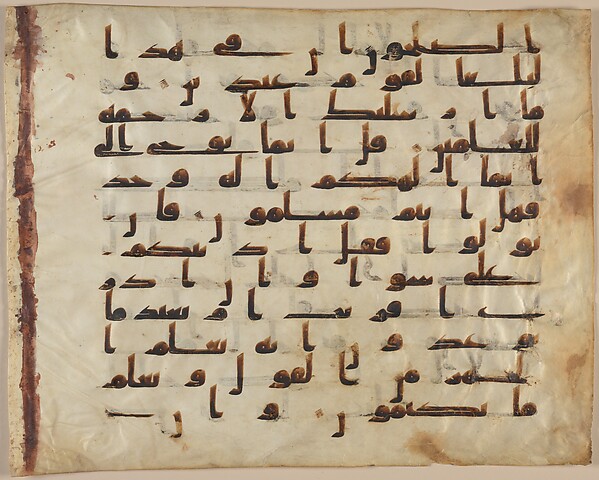
Manuscripts let historians examine physical witnesses independently of accepting a collection report. In a 2019 study, Marijn van Putten found shared unusual spellings across early Qur’anic manuscripts of the Uthmanic text type. He argues that these agreements indicate descent from a written archetype, rather than independent copying from memory. This supports early written standardization; it does not verify every conversation reported about Abu Bakr or Uthman.
This gives us a firmer but still bounded result: evidence for shared written ancestry. Descendants can agree because they share an ancestor, without preserving a record of everything before that ancestor. A manuscript’s date is also not automatically the date when its text was composed. Early stability is historically significant; moving from that result to a claim of divine origin requires different reasons. Christian manuscripts must meet the same distinction between what survives, how it was transmitted and why it should be believed.
Which part of the original argument remains?
The evidence now lets us separate Gilchrist’s useful challenge from his stronger conclusion. Collection, selection of witnesses and standardization are present in the received account; treating them as matters for investigation is justified. But Bukhari 4986 does not establish irretrievable loss at Yamama, and the separate loss allegation carries its own transmission problem. The conclusion is therefore narrower than Gilchrist’s: this tradition describes organized human preservation, while claims of actual loss or exhaustive perfection need evidence beyond the features examined here.
The strongest Muslim response does not need to deny that process. God could preserve the text through human care, consistent with Qur’an 15:9. Because divine protection and human activity are compatible, finding the latter does not refute the former. But for a reader still investigating the Qur’an’s authority, the promise cannot independently establish the authority on which confidence in that promise rests. This is a boundary of the historical argument, not a judgment that Muslim trust is insincere or irrational: the theological claim requires its own case. If preservation is offered as the reason to accept the Qur’an as God’s word, the missing step is why preservation establishes that authority. If human copying is then used to dismiss the Bible, the criterion is inconsistent with accepting human care as a possible means of divine preservation. These particular arguments fail; this finding does not pretend to disprove Islam as a whole or establish Christianity without its own evidence.
A fair biblical comparison
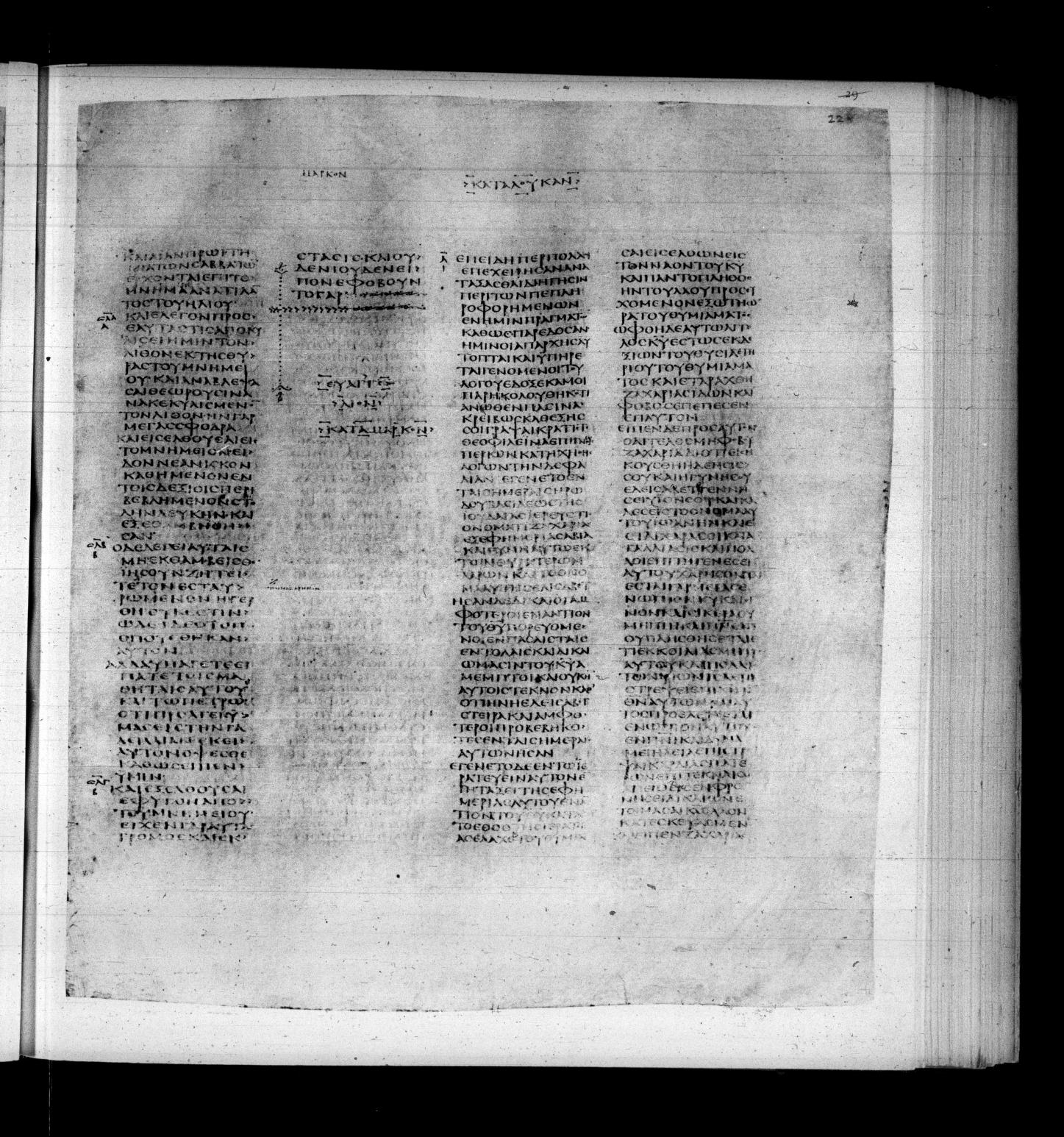
The Bible is a collection of writings, so its history is not an exact parallel to the collection of the Qur’an. We can nevertheless compare a precise issue: does evidence of copying and textual variation make the earlier religious message unavailable? For the New Testament, the fourth-century Codex Sinaiticus is a concrete witness predating Islam. Its surviving contents include the New Testament as well as other early Christian writings, reminding us to distinguish the boundaries of a collection from wording inside a book.
Sinaiticus also prevents an idealized Christian account. Its Gospel of Mark ends at 16:8, without the longer ending, 16:9–20, familiar from many later Bibles. Hugh Houghton’s discussion of the manuscript notes that it nevertheless contains resurrection narratives in Matthew, Luke and John. Thus recognizing a substantial textual question in Mark does not remove resurrection proclamation from the surviving pre-Islamic Christian record.
The positive reason for biblical inquiry is now concrete. A reader can examine a pre-Islamic form of the message about Jesus even while acknowledging a substantial difference in Mark. The evidence does not prove the events narrated, settle which ending Mark originally wrote, or establish the inspiration of every book. A Muslim critic may argue that alteration occurred before our surviving witnesses. That possibility calls for evidence about the particular text and proposed change; merely naming it does not demonstrate that the accessible Christian message is a late replacement. The existing witness gives us something specific to examine rather than a choice between trusting every detail and abandoning the whole text.
Contemporary New Testament textual work does not require pretending all copies agree. The University of Münster’s Institute for New Testament Textual Research describes its task as documenting the textual tradition and reconstructing its initial text. Comparing witnesses is a method for evaluating differences, not a guarantee that every reading becomes certain. The corresponding duty for Christian argument is to acknowledge the differences it can identify and defend only the conclusions the evidence supports.
What the comparison allows us to conclude
Collection history changes the question we should ask. On the Qur’anic side, the reports describe active preservation and an officially established written standard, while manuscript research supports shared written ancestry. Those findings do not establish every detail claimed for perfect preservation or justify an unsupported accusation of lost revelation. They do show why “people collected it” is the beginning of an investigation, not its verdict.
Apply that lesson to a precise biblical claim. If the claim is that Mark’s longer ending is absent from Sinaiticus, the witness supports it. If the claim is that this absence removes resurrection testimony from that manuscript, the other Gospels challenge it. The surviving record therefore gives a positive reason to examine Christian testimony about Jesus. Whether his death and resurrection occurred, and what they mean, must then be assessed with historical and theological reasons of their own. We can pursue those questions without asking the number or uniformity of manuscripts to prove what only a fuller argument could establish. The reason to consider the God proclaimed in that Christian testimony is therefore concrete: its message remains available for evaluation, and the proposed preservation-based reason for excluding it does not hold. Whether to trust that message requires the fuller inquiry that collection history makes possible but cannot replace.
Sahih al-Bukhari 4986 · Sahih al-Bukhari 4987 · Smithsonian National Museum of Asian Art, Codex Sinaiticus · University of Münster, Institute for New Testament Textual Research