


Start where the accounts disagree
The most useful starting point is Jesus: did he die, and what explains the proclamation that he rose again? Here the evidence gives a reason to prefer the Christian account. Jesus’ death and the proclamation of his resurrection belong to the earliest recoverable Christian message. The usual Islamic denial of his crucifixion conflicts with that early testimony. Accepting the denial therefore requires a reason to overturn the earlier account, not simply the assurance that the Qur’an is a later revelation.
This does not ask you to accept the Bible’s inspiration before examining it. Read its documents first as historical sources: who is speaking, how close is the writer to the events, and what can be checked? A letter does not cease to be evidence because a religious community later included it in scripture. Nor does inclusion in scripture exempt it from examination.
The comparison has a direction. If the Christian account is better supported at the point where the two accounts conflict, that is a reason to move toward Christianity. To take the next step, we must also examine the positive Christian explanation of Jesus’ resurrection and what his death means. Finding a weakness in Islam alone would leave that work unfinished.
For I delivered to you first of all that which I also received: that Christ died for our sins according to the Scriptures, that he was buried, that he was raised on the third day according to the Scriptures, and that he appeared to Cephas, then to the twelve.
But they neither killed nor crucified him
Qur’an 4:157–158Mustafa Khattab, The Clear Quran
The Christian message was there in the first generation
In 1 Corinthians 15:3–8, Paul sets out a message he had received and passed on: Jesus died for sins, was buried, was raised, and appeared to named people, including Peter and James. First Corinthians was written in the mid-50s AD; the USCCB introduction dates it about 56. The letter places this proclamation within the first Christian generation, rather than centuries after Jesus.
Paul also gives us a connection to the people named. In Galatians 1:18–19 he reports staying with Peter for fifteen days and meeting James, Jesus’ brother. We do not have a transcript of those meetings. What we do have is an identifiable writer reporting personal contact with central figures in the original movement. In 1 Corinthians 15:11 he presents the proclamation as shared by himself and the other apostles. Galatians 2:1–10 adds a later visit and recognition of his mission by James, Peter and John. These passages support continuity with the Jerusalem leaders, not agreement on every disputed matter. The explanation that Jesus’ death and resurrection were invented only centuries later does not fit this evidence.
Paul was also a participant, not merely a collector of distant stories. He describes his earlier persecution of the church in Galatians 1:13 and includes himself among those to whom Jesus appeared in 1 Corinthians 15:8. His own account thus requires an explanation of a change from opposition to proclamation. Its historical value lies in access, early date and concrete claims; accepting every claim he makes is the conclusion to investigate, not the admission price for reading him.
Tacitus supplies a later Roman perspective. Annals 15.44 reports Christus’ execution under Pontius Pilate during Tiberius’ reign. Tacitus wrote in the early second century and was no eyewitness to the execution; he does not name his informant. His hostile account nevertheless shows the execution reported outside Christian preaching. It supports the death claim, not the resurrection. We should neither discard a useful source because it is later nor count it as an independently verified Roman archive.
Paul explicitly names crucifixion in 1 Corinthians 1:23: the message he preached was Christ crucified. We are not inferring the form of Jesus’ death from the later Roman account alone. The resulting judgment is definite: Jesus’ death by crucifixion is supported by early Christian testimony connected to the original movement and a later Roman report of execution. Denying that death must explain why this evidence is misleading. That is a stronger basis for comparison than deciding which religion sounds simpler.
about the year 56.
but we preach Christ crucified
1 Corinthians 1:23, World English BibleWorld English Bible (public domain)
Then after three years I went up to Jerusalem to visit Peter, and stayed with him fifteen days.
Galatians 1:11–20, World English BibleWorld English Bible (public domain)
gave to Barnabas and me the right hand of fellowship
Galatians 2:1–10, World English BibleWorld English Bible (public domain)
Christus had been executed during Tiberius’ reign through the procurator Pontius Pilate.
Tacitus, Annals 15.44: Dickinson College commentaryEditorial translation from Tacitus’s Latin
Can a later revelation correct the earlier testimony?
Qur’an 4:157–158 says Jesus’ opponents neither killed nor crucified him and that God raised him to himself. The common Muslim interpretation is that Jesus escaped crucifixion. The verses themselves do not name a substitute. Muslim writer Justin Parrott discusses substitution as the majority interpretation, while also describing other readings. A minority reading compatible with Jesus’ bodily crucifixion changes this particular disagreement; it does not establish the Christian account of his identity or resurrection.
Compare the common denial with the evidence just examined. The Christian documents place death and resurrection at the beginning of the movement and connect their writer with its central figures. The Qur’anic account comes from the seventh-century setting and supplies no earlier historical witness in these verses to displace them. On the historical evidence considered here, Jesus’ actual death is better supported than the claim that he escaped crucifixion. The reason is the quality and access of the testimony, not a rule that every earlier statement must be true.
The strongest Muslim reply is that God can reveal what witnesses misunderstood. Qur’an 5:48 presents the Qur’an as an authority over previous scripture; Ibn Kathir’s commentary develops its role as witness and judge. If the Qur’an is established as God’s revelation, that would matter. But someone deciding whether to accept that authority cannot use the authority itself as the entire proof. “The Qur’an corrects the witnesses because the Qur’an says so” gives the investigator no independent reason to reject them.
A Muslim may therefore appeal to prophecy, the Qur’an’s language or evidence for Muhammad’s mission. Those are arguments to test, not forbidden lines of inquiry. The present comparison establishes what they would need to overcome: an earlier, concrete body of testimony supporting Jesus’ death. Calling that testimony corrupted is not yet an explanation. The claim needs evidence of what changed and when, or evidence that the original witnesses were mistaken.
A substitution account can allow the early witnesses to be sincere: they reported what appeared to happen while the real event was different. Early testimony alone cannot logically exclude that possibility. The reason to prefer an actual crucifixion is that it accounts for the reported event without adding an otherwise unestablished substitution. To prefer the hidden event, we need supporting evidence for that intervention or for the revelation claiming to disclose it.
The same standard applies to Paul’s claim to revelation in Galatians 1:11–12. His claim does not authenticate itself either. His testimony receives historical weight from its early setting, named contacts and participation in the movement. The comparison asks which account has reasons supporting it before its religious authority is assumed.

there are other plausible interpretations of the verse
Justin Parrott, Jesus: A Foundation for Dialogue (2018), pp. 39–42, 49–50
as a confirmation of previous Scriptures and a supreme authority on them.
Qur’an 5:48Mustafa Khattab, The Clear Quran
a witness, and dominant over every Scripture that preceded it.
A surviving text lets us investigate the claim
How do we reach those early documents if their surviving copies are later? Consider P46, a papyrus collection of Paul’s letters conventionally dated around AD 200. Its catalogue date concerns the physical copy. The composition of a letter is a separate question, assessed from its setting, contents and relationship to other evidence. A copy made later does not mean the letter was composed at that later date.
The photograph here shows a real surviving witness to the letters’ transmission. It is not Paul’s original manuscript, and the pictured leaf is not the page containing 1 Corinthians 15. Its value is tangible access to the textual tradition. It helps us see why the Christian account can be investigated rather than accepted as an inaccessible claim about a lost book.
Transmission, historical reliability and divine authority form a sequence of questions. First ask what the text says; then whether its report is credible; then what grounds support its claim about God. Accurate copying cannot make a false report true, but access to the wording lets us test the report. Conversely, a copying variation does not make every event in a document fictitious. A manuscript count or a standardized text cannot replace that investigation.
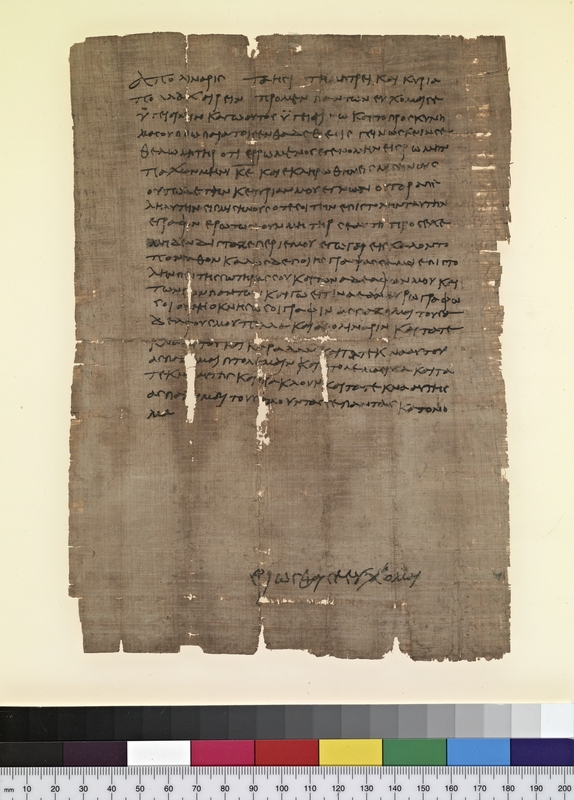
These papyri are valuable to contemporary Biblical scholars
Late second century or early third century (c. 200)
Why the resurrection is a positive explanation
Once Jesus’ death is accepted, the next question is why his followers proclaimed that he had been raised and had appeared to them. Paul’s letter gives us early proclamation, named recipients of appearances, his contact with Peter and James, and his own reported change from persecutor to apostle. These observations give the Christian explanation something specific to explain. It is not a miracle introduced to rescue a story with no historical setting.
Compare the explanations. A theory that the resurrection message arose only centuries later fails the early-letter test. Deliberate invention must account for the claims of people presenting themselves as participants; calling them liars without evidence does no more explanatory work than calling them infallible. Sincere but mistaken religious experiences offer a more serious alternative: people can report an experience honestly while interpreting it wrongly.
The Christian explanation is that God raised Jesus, and the proclamation arose because people encountered him alive. It connects the evidence in one account: Jesus really died; the movement proclaimed appearances from its first generation; Paul joined that proclamation after his reported encounter; and his message remained connected with Peter and James. Compared with a centuries-late invention or an escape from crucifixion, resurrection fits this connected early testimony. That is a positive argument for the Christian explanation, rather than an argument from Islam’s weakness alone. Mistaken religious experiences remain a serious alternative; the early date and sincerity of witnesses do not by themselves eliminate it. A fuller judgment needs closer examination of the appearance accounts.
Paul’s report of more than five hundred people is one surviving report about a group, not five hundred separate accounts available to us. His list does not itself describe an empty tomb. Nor can the four Gospels simply be counted as four unrelated witnesses without examining their literary relationships. The positive case rests on the testimony we actually have.
Paul makes the stakes unusually clear in 1 Corinthians 15:14–19: if Jesus was not raised, Christian proclamation and hope fail. Christianity therefore offers a claim that can be challenged at its center. The right response to the early evidence is to investigate that claim, rather than dismiss Jesus’ death and resurrection as a late Christian alteration.
Is the Trinity a contradiction?
Qur’an 112 affirms God’s oneness and denies offspring or an equal; Qur’an 4:171 rejects speaking of Three. Nicene Christianity also affirms one God, while distinguishing Father, Son and Holy Spirit. The Catholic Catechism, paragraphs 252–255, states the distinction as one divine nature and three persons. Here “person” identifies who the Father, Son and Spirit are; it does not mean three separate gods sharing a category.
An arithmetic contradiction would assert that God is one and three in the same respect. That is not the doctrine being proposed. One divine nature and three persons is a different claim from one god and three gods. A Muslim critic can still challenge whether the distinction is coherent or true. The Christian answer must explain the distinction and its grounds; merely repeating “three cannot equal one” never reaches the actual claim.
There is a source-based reason to investigate the Christian distinction. In 1 Corinthians 8:4–6, Paul affirms that there is one God and then speaks of one God, the Father, and one Lord, Jesus Christ, through whom all things exist. The same early writer holds monotheism together with this extraordinary role for Jesus. A Christian account must explain both parts of that testimony, rather than preserve one by deleting the other. This passage is a starting point for understanding Christ’s divine identity, not a complete later formulation of the Trinity.
This shows why apparent simplicity cannot decide the comparison. A shorter explanation wins only when it accounts for the relevant evidence at least as well. Occam’s razor favors avoiding unnecessary assumptions, not discarding inconvenient evidence. If God has acted through Jesus, our understanding of God must account for that action, rather than exclude it because a different description is easier to state.
The Catechism also connects the Trinity with God’s eternal life and love. This gives a positive Christian account: love is not something God first acquires after creating another being. It belongs to the eternal communion of Father, Son and Spirit. That account makes the doctrine meaningful. The sentence “God is love” alone is not a deduction proving three persons; the Christian case belongs with the evidence of God’s self-disclosure through Jesus.

He has never had offspring, nor was He born.
Qur’an 112:1–4Mustafa Khattab, The Clear Quran
Allah is only One God.
Qur’an 4:171Mustafa Khattab, The Clear Quran
one God in three persons
and one Lord, Jesus Christ, through whom are all things
1 Corinthians 8:4–6, World English BibleWorld English Bible (public domain)
other things being equal, simpler theories are better.
What the cross reveals about God
The historical comparison leads to a personal question: if Jesus really died and God raised him, what was God doing? Romans 5:6–11 answers by describing Christ’s death for sinners as God’s initiative in reconciliation. The movement is from God toward people who have not first made themselves worthy. This is the positive Christian invitation: trust the God who acts to reconcile, rather than treat Jesus only as a messenger whose saving death must be denied.
John 10:17–18 presents Jesus’ self-giving as voluntary. Read within the Christian account of the Son, the cross is not a detached God forcing an unrelated, unwilling victim to suffer. God’s saving action involves the Son’s willing self-giving. That answers an important objection about coercion. Questions about the justice and meaning of atonement deserve fuller treatment; willingness by itself does not settle them.
Jesus’ death has historical support; the received proclamation already calls it a death “for our sins”; Romans 5 explains this as reconciliation; resurrection, if established, would be God’s vindication of Jesus rather than his final defeat. The saving meaning of the cross belongs to the early message itself. It was not added to an otherwise unrelated death centuries later. Resurrection would give a reason to trust Jesus and examine that message as God’s action, while its meaning comes from the proclamation and must be assessed with it.
There is no need to deny Islamic teaching about mercy to make this case. Qur’an 85:14 names God as forgiving and loving, and 39:53–54 calls sinners to return to him. A Muslim can reasonably ask why forgiveness should require the cross. The Christian case must explain God’s action through Jesus, not pretend Muslims have never heard of forgiveness. A courtroom fine analogy cannot prove that punishment may justly be transferred or that God has no other possible means of forgiveness. The argument concerns this claimed saving act, examined through its evidence and meaning.
But God commends his own love toward us, in that while we were yet sinners, Christ died for us.
No one takes it away from me, but I lay it down by myself.
And He is the All-Forgiving, All-Loving—
Qur’an 85:12–16Mustafa Khattab, The Clear Quran
Turn to your Lord
Qur’an 39:53–54Mustafa Khattab, The Clear Quran
A comparison should reach a conclusion
The evidence considered here favors the Christian account of Jesus’ death over the common Islamic denial. The Christian resurrection proclamation is also early and connected to the original movement. Together these give a positive reason to take Christianity’s central claim seriously, rather than begin by assuming that Islam has corrected it. The next task is to examine the resurrection explanation in detail, not to restart the comparison as though nothing has been learned.
No percentage is needed to express that judgment. A claim that Christianity is “95 percent true” requires defined hypotheses, alternatives and defensible probability assumptions. Bayesian reasoning can clarify how evidence changes a judgment; it cannot manufacture measured odds from an impressive list. Ten copies of one report are not ten independent witnesses. Nor does evidence against Islam automatically eliminate every alternative to Christianity.
The same discipline applies beyond this example. A verified ancient place can support a geographical detail without proving divine inspiration. A fulfilled-prophecy argument needs a dated text, a defensible reading and an actual fulfillment. Population growth or political success does not establish revelation. A reason to believe in a creator does not by itself identify which revelation comes from that creator. These distinctions help us follow evidence toward a conclusion without counting the same fact repeatedly or assigning it a job it cannot do.
Begin with 1 Corinthians 15:1–19 beside Qur’an 4:157–158. Ask which account better explains the evidence already examined. Then read Romans 5:6–11 to see what the Christian account says that event means for you. This is a reasoned path toward Christian faith: start with a supported historical judgment, investigate the resurrection, and consider the God made known through Jesus’ saving action.
used for calculating conditional probabilities