


What accurate transmission gives us
A faithfully preserved scripture gives later readers access to an earlier message. It does not, by itself, establish the truth or divine origin of that message. The reason is straightforward: a copy can reproduce an accurate statement or a mistake with equal fidelity. Preservation matters to our knowledge of what was said; assessing whether to believe it requires examining the claim and its source.
Consider an invented forecast predicting rain tomorrow. Copying it without error preserves the prediction. Observing tomorrow’s weather tests its accuracy. If a copy accidentally substitutes sunshine for rain, identifying that error matters because it changes what we attribute to the forecaster. The example illustrates why transmission is important and why it cannot replace investigation of content; it makes no allegation about a scripture’s history.
This applies to a comparison between scriptures too. Even if one text were transmitted more faithfully than another, that ranking alone would not establish which, if either, came from God. Better access to a claim is not the same thing as evidence establishing its divine source. If a message was not divinely revealed when first given, accurate copying could not change its origin. These are conditional claims, not findings that either the Qur’an or the Bible is nondivine.
Three questions now become easier to separate. Transmission concerns the wording that has reached us and the uncertainties surrounding it. Historical reliability concerns whether reported events happened and whether the authors could know about them. Divine authority concerns the reasons for accepting a message as revelation. Evidence relevant to one question may contribute to another, but the connection needs to be shown. Preservation can support a wider argument; saying it has no evidential value would go beyond the distinction. For someone weighing Islam against Christianity, confidence that the Qur’an’s wording has survived cannot, by itself, justify accepting its divine authority or rejecting a competing claim about God.
Why the kind of change matters
The same reasoning prevents the opposite mistake: assuming that every change makes a text less true. Imagine an arithmetic textbook that prints 7 × 8 = 54. A corrected edition gives 56. The text has changed, but this particular mathematical statement has become true. We therefore cannot infer the truth of a statement from the bare fact that its wording changed or stayed the same. We must examine the change and the statement.
An added explanation or a previously omitted chapter can also make a textbook more complete without making its earlier true statements false. Correcting an error and supplying missing treatment are different improvements. Successive editions can contain both; simply counting editions or changes would tell us little about their effect. These hypothetical examples explain the logic of revision, not what occurred in the transmission of either scripture.
A third possibility is a true statement that survives a difference without losing its meaning. A spelling variation need not make the assertion false. Yet a small alteration can matter enormously: removing a crucial negation may reverse what is said. The size of a copying error is therefore no guarantee of its harmlessness. Claims that all changes destroy truth and that all copying errors are insignificant both evade the question of meaning.
There is also a difference between recovering an earlier wording and deciding to improve what an author originally said. A textbook editor may correct content; a textual researcher may instead be trying to establish exactly what an earlier writer wrote, including any mistake. The editor’s freedom to revise a textbook does not settle a scripture’s authority or authorize rewriting it. For religious texts, the specific change, its history and the claim made for the text all need attention.
The Qur’an’s promise and the stronger argument
Qur’an 15:9 presents God as both the sender and guardian of the Reminder. In the surrounding passage, 15:6–9, opponents mock the recipient of revelation and demand angels. Ibn Kathir’s commentary identifies the Reminder as the Qur’an and understands its protection as protection from alteration. This presents preservation as divine care for revelation, not merely the survival of an old document. It is a sourced interpretation, without implying that every Muslim defines preservation in precisely the same way.
A believer who accepts this revelation can trust its promise within that faith. An investigator asks what supports accepting the message as divine. Quoting 15:9 identifies the claim being considered; used as the sole proof of its own authority, it assumes the point at issue. This limitation applies to that particular argument. It does not show that every Muslim’s reasoning is circular, just as quoting the Bible to explain Christian belief need not be an attempt to prove it by quotation alone.
The strongest relevant challenge is more substantial: perhaps a preservation promise, followed by evidence of its fulfillment, supports divine origin. It can be joined to further reasons concerning the message and Muhammad’s prophetic claim. Qur’an 4:82 itself invites reflection on the text and links the absence of extensive inconsistency with its divine source. Whatever judgment an investigator makes about that argument, the verse shows why it is unfair to reduce the Qur’anic case to the survival of copies.
An investigator can test a promise and its apparent fulfillment without first accepting the text as revelation. Nor must each part of a combined case prove the conclusion by itself: several considerations may become persuasive together. This is a reconstructed strong reply, not a claim to speak for every Muslim. It succeeds against the suggestion that preservation can never matter. The narrower point remains: accurate transmission alone does not establish revelation.
The task then is to define what preservation was promised, examine the relevant evidence, and explain why the result supports divine origin. Pointing to a possible human explanation does not, by itself, defeat a divine one. A believer may understand careful copying and memorization as means of providence. Conversely, calling the outcome remarkable does not yet explain what gives it specifically divine significance. Both the proposed connection and alternative explanations deserve assessment.
This article does not decide that complete cumulative case. It identifies what a successful argument would still need to explain. The same standard applies to a Christian who calls the Bible providentially preserved: neither confidence nor a rival argument’s weakness supplies the missing connection between transmission and divine authority.
It is certainly We Who have revealed the Reminder, and it is certainly We Who will preserve it.
He is the One Who revealed the Dhikr to him, which is the Qur'an, and He is protecting it from being changed or altered.
Do they not then reflect on the Quran? Had it been from anyone other than Allah, they would have certainly found in it many inconsistencies.
Reading the Birmingham evidence within its limits
The preservation question also concerns how a text is handed on. Yousef Wahb’s account at Yaqeen Institute treats recitation and writing as complementary. A manuscript is therefore one kind of evidence within a wider Muslim account that also appeals to oral transmission. Examining a fragment cannot substitute for evaluating that whole account, and citing Wahb here does not verify every historical or comparative claim in his study.
The University of Birmingham identifies its Qur’an fragment as Mingana Islamic Arabic 1572a: two parchment leaves containing 18:17–31, 19:91–98 and 20:1–40. Its published radiocarbon result places the animal’s death in 568–645 CE at 95.4% confidence. The university distinguishes the age of the skin from the age of the writing; the inks have not been age-tested.
The distinction changes what we may infer. A date for the parchment does not identify the scribe or show that Muhammad personally saw these leaves. Dating the writing requires additional judgment. At the same time, the leaves are meaningful early material evidence: researchers have an actual witness to particular passages that can be compared with other witnesses. Evidence favorable to preservation should be acknowledged, not discounted because it is favorable to a Muslim argument.
That comparison has a defined scope. Two leaves cannot certify every verse, spelling, reading tradition or intervening copy of the whole Qur’an. Establishing complete identity would require specifying what is being compared and considering much wider evidence. No such comprehensive collation is offered here, and the fragment’s limits are not evidence that the remaining text was lost or changed.
Keep the dates distinct as well: the age of parchment, the composition of a work, the production of a surviving copy and the appearance of a standardized edition are different questions. A century label cannot replace examination of the actual witnesses. Even a fully demonstrated transmission history would leave the question of divine origin; it would give that inquiry dependable access to the message rather than make the inquiry unnecessary.
This article, however, focuses on the preservation of the Qur’an, orally and textually during the time of its first recipient and conveyor, Prophet Muhammad ﷺ.
Yousef Wahb, How the Qur’an Was Preserved During the Prophet’s Time
The radiocarbon result gives the date range for the death of the animal whose skin was used to make the parchment of the manuscript.
What Mark’s disputed ending does—and does not—decide
The same care is necessary when a biblical text has a real transmission problem. The English Standard Version places a notice before Mark 16:9–20 explaining that some of the earliest manuscripts do not include those verses. Its note also identifies differing endings in the manuscript tradition. A twelve-verse passage is a substantial difference; describing it as merely spelling would avoid the evidence.
If an argument depends on something found only in that ending, its textual status belongs in the argument itself. We must examine the witnesses rather than treat the passage’s original form as uncontested. That conclusion has limits: it does not establish that every statement in Mark, every other New Testament book or every report about Jesus is false. Equally, identifying one known problem does not certify all the remaining passages. Confidence must be assessed where a claim depends on it.
Authorship and acceptance as scripture are distinct questions too. The Revised Standard Version Catholic Edition’s note treats the ending as canonical and inspired even if Mark did not write it. That records a Christian judgment about scriptural authority, not proof that Mark originally wrote those verses and not a view attributed here to all Christians.
Comparing witnesses helps us identify the text whose claims we are considering. Their disagreement is not, by itself, evidence that a reported event never happened; their agreement alone would not demonstrate that it happened. Textual criticism and historical inquiry thus have connected but different tasks. A change may be significant for one claim without deciding every question about the whole collection.
This is why moving to another biblical witness can be a legitimate investigation, provided its reliability is examined rather than assumed. A difficulty in Mark’s ending does not settle the content or credibility of Paul’s letter. To assess that letter, we need reasons that bear on it.
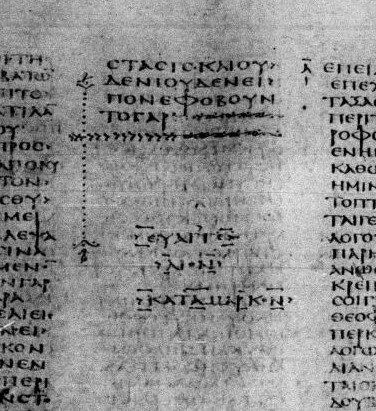
Some of the earliest manuscripts do not include 16:9–20.
This passage is regarded as inspired and canonical scripture even if not written by Mark.
A concrete reason to examine Paul’s testimony
In 1 Corinthians 15:3–8, Paul passes on a message about Jesus’ death, burial, resurrection and appearances. He names Cephas, also known as Peter, and James, refers to groups, and includes himself among those to whom Christ appeared. The USCCB introduction dates the letter to about 56 CE and treats it as Pauline. This gives the inquiry a specific report from the first Christian generation, rather than an assertion whose existence depends on Mark 16:9–20.
The date is a scholarly judgment about composition, not the date of an original manuscript now in our possession. It is a reason to investigate the letter as early testimony, not a guarantee that the reported events occurred. A Muslim or skeptical reader can examine what Paul reports and how he could know without first accepting the letter as inspired.
Paul also states why the event matters. In 15:12–20 he addresses believers who deny resurrection of the dead: if the dead are not raised, then Christ has not been raised. In verses 14 and 17 he makes the value of Christian proclamation and faith depend on Christ’s resurrection. In verse 15 he identifies God as the one who raised Christ. He affirms that the resurrection happened; he is not suspending his belief. Using this dependence as a starting point for historical investigation is our application of his argument, not a claim that Paul was conducting a modern neutral experiment.
The limits of his report belong beside those reasons for examining it. His account of more than five hundred people is one author’s report, not five hundred surviving independent depositions. Naming people does not guarantee that their testimony was correct. His statement that he received the message does not by itself date every part of its wording. An early account can be mistaken, and religious conviction can affect interpretation.
A historical case for the resurrection therefore needs a fuller comparison of sources and competing explanations than this article supplies. Early testimony alone does not settle the disagreement about Jesus or establish Paul’s divine authority. Christians must argue for the report’s reliability rather than assume it because it belongs to the Bible; criticism of an Islamic argument cannot establish their case.
Yet these limits do not remove the reason to investigate. We have an identifiable early proclamation, named people within its account, and an explicit connection between the reported event and the faith built on it. Those features give us concrete questions about access to knowledge, reliability and explanation. The distinction between preservation and truth allows us to acknowledge early Qur’an evidence, take a biblical textual difficulty seriously, and still examine this testimony about Jesus on its own merits.
For a reader whose confidence in Islam rests on preservation, the conclusion is specific: that reason alone does not establish Qur’anic authority and cannot exclude Paul’s competing claim about God. His testimony directs us toward the Christian proclamation that God raised Jesus. Assessing it requires more than comparing the survival of books: a manuscript comparison can clarify wording, and a dated letter can establish an early report, but reasons for trusting that report must then be argued. If the report is true, the Christian account of God’s action in Jesus calls for a response; this article has not established that condition. The next issue is therefore whether Paul’s testimony deserves trust, not simply whether his words survived.
For I delivered to you first of all that which I also received: that Christ died for our sins according to the Scriptures, that he was buried, that he was raised on the third day according to the Scriptures, and that he appeared to Cephas, then to the twelve. […] If Christ has not been raised, then our preaching is in vain and your faith also is in vain.
To treat this wide spectrum of questions, Paul wrote this letter from Ephesus about the year 56.