


One question contains several different claims
Can someone who does not know Arabic understand the Qur’an through a translation? Yes: a rendering can communicate an understanding of its teachings. But that answer leaves three further claims to test: whether it reproduces all the original’s literary qualities, whether the translated sentences have the same religious status, and whether they may replace Arabic in formal Muslim prayer. The usefulness of a translation does not depend on proving all three.
Here, translation means rendering meaning in another language. Tafsir means explanation or commentary, which may be in Arabic or another language. Transliteration represents words using a different writing system without changing their language. Salat is the prescribed ritual prayer; it should not be confused with every personal request addressed to God. These distinctions will keep a statement about one activity from becoming an unsupported rule about all the others.
The argument turns on a difference between conveying something and replacing it in every respect. If a translation enables a reader to grasp a teaching, it has achieved communication even if some literary force is lost. Permission to use it in a prescribed rite needs an additional premise about what that rite requires. The historical disagreement is therefore evidence about the reasons different authorities gave for a use of translation; disagreement itself proves neither that all translations are acceptable nor that none can teach.
We will first examine what crosses a language boundary and what may change with it. That makes the strongest objection to replacement intelligible before we turn to the jurists’ arguments and their early reports. We can then ask what Arabic form or translation loss actually establishes about divine authority, and examine the Christian claim that God makes himself known through the Son. The language question must not decide in advance which account of Jesus we are willing to hear.
An Arabic revelation addressed beyond Arabic speakers
Qur’an 12:2 links its Arabic form with understanding. Qur’an 14:4 connects a messenger’s language with explaining the message to his people, while 34:28 presents Muhammad as a bearer of good news and warning to humanity. Together they identify a real problem of communication, not a contradiction by themselves: a message can originate in one language and reach readers of others.
Qur’an 85:21–22 also places the Qur’an in a Preserved Tablet. In the legal reasoning examined below, beliefs about divine speech bring further questions about what remains identical across different human expressions. A scriptural statement about heavenly preservation and a historical claim about a particular translation are different kinds of claim; one does not automatically verify the other.
A non-Arabic speaker might learn Arabic, receive an explanation through an interpreter, or do both. Each route can serve a different purpose. Someone may understand a passage through an explanation while still learning its recitation. Conversely, producing its sounds need not establish understanding of every sentence.
Al-Zamakhshari addresses the objection directly in al-Kashshaf on 14:4: if non-Arab peoples are included, could they not plead that they do not understand the language? His reply is that revelation need not be delivered separately in every tongue. Its first hearers understand and transmit it, and translations explain it to others. Here tarjamah can include explanatory rendering. The community’s task of communicating the message can therefore use other languages without deciding which language must be recited in prayer.
The verses establish how the Qur’an presents its language and mission. They do not by themselves supply a detailed legal ruling on every translation, teaching situation or disability. Those applications require the additional reasoning of interpreters and jurists.
Qur’an 85:21–22 · Al-Zamakhshari, al-Kashshaf on Qur’an 14:4
A sentence can preserve an event and change its force
Start with a small example rather than a rule about an entire scripture. Al-Shatibi’s al-Muwafaqat, volume 2, pages 105–107 in the transcription consulted, considers different ways of reporting that Zayd stood up. Word order, emphasis and the hearer’s expectations can change what a speaker is doing with the information, even when the event being reported remains the same.
For example, answering a neutral question and correcting a denial may communicate the same event with different force. A translator who identifies the event has achieved something real. Whether the same sentence also carries the original emphasis is a further question.
Al-Shatibi uses this distinction to separate basic meaning shared across languages from further implications carried by a particular expression. He permits transfer of the basic meaning and relates it to the accepted practice of explaining scripture. Complete transfer of supplementary features would require an equivalence between languages that he regards as difficult to demonstrate. His answer therefore recognizes both an intelligible message and a limit on what a rendering can claim.
The strongest objection to this distinction is that basic and supplementary meanings can interact: emphasis can change what a hearer takes the speaker to mean. That is a reason to examine whole passages, not merely isolated words. It does not eliminate the distinction between a partial but useful understanding and a claim to reproduce every feature.
Modern Dar al-Ifta guidance also recognizes that translators make interpretive choices. An Arabic reader, too, must resolve questions of context and meaning. Translation adds an interpretive step; it does not create the existence of interpretation from nothing.
Al-Shatibi, al-Muwafaqat 2:107 · Dar al-Ifta, The accuracy of the different translations of the Quran, 25 February 2015
Al-Ghazali’s concern: changing what an attribute suggests
Sometimes a change in associations affects more than emphasis. Al-Ghazali’s Iljam al-awamm raises this danger for expressions about God’s attributes. In the passage reproduced at length in Tafsir al-Manar, his concern is how non-specialists handle those transmitted expressions: an apparent Persian equivalent may suggest a bodily image or ordinary association different from the Arabic expression’s use.
The warning is not a successful proof that every Qur’anic meaning is impossible to explain. The passage acknowledges that some expressions have equivalents. Its precaution concerns a sensitive theological setting in which an unwary substitution may change what a reader thinks is being said about God.
This gives the translator a task that a dictionary alone cannot complete: consider what a reader will take the word to imply in this passage. A note or explanation may preserve an intended distinction more responsibly than a short replacement. The practical standard is therefore fidelity to the passage’s meaning in context, not simply finding one word for another.
At the same time, caution can itself be examined: which expression creates the risk, which interpretation is being protected, and what evidence shows the proposed alternative misleads? The strongest version of the objection concerns identifiable semantic risks. A blanket claim that all translation necessarily falsifies the text goes beyond this passage.
Al-Qaffal’s objection: an explanation does not claim to replace everything
These semantic limits explain why someone might accept commentary yet resist a translation presented as a complete replacement. Al-Suyuti’s al-Itqan, type 35, question 20, paragraphs 1428–1429 in the opened transcription, reports this objection from al-Qaffal: a commentary may explain some meanings without capturing all of them, whereas a substitute would need to convey the full meaning of what it replaces. This is al-Suyuti’s report, not an independently checked transcript of al-Qaffal speaking.
This helps explain why the same person could accept commentary while resisting translation conceived as complete replacement. Commentary openly accompanies an original that remains available. Its partial character need not be concealed.
But a modern translation need not make the stronger claim. It can identify itself as an interpretation, retain the Arabic alongside it, and acknowledge uncertainties. Under those conditions, the objection gives criteria for responsible presentation rather than proving that every translated explanation is illegitimate.
The remaining disagreement is real: does a particular religious act require the original form even when an explanation is accurate? A careful label cannot by itself resolve that legal question. It can prevent a reader from mistakenly treating a translator’s decision as the only meaning the original permits.
Dar al-Ifta, Interpreting and teaching the Quran in non-Arabic languages, 4 March 2015
Why a useful translation may still not count as the Qur’an
There is a further objection that even an exceptionally careful translation cannot answer by accuracy alone: the identity of the revealed text. The International Islamic Fiqh Academy’s 2023 resolution defines the Qur’an through meaning and structure together, Arabic revelation, transmission and the text contained in the mushaf—the written codex. Within that institutional theological and legal definition, conveying meaning does not give a translator’s sentences the original’s status.
This explains an objection that otherwise sounds puzzling. A scholar can welcome an explanation and still deny that the explanation is itself the Qur’an. The claim is about the identity and use of a particular text, not necessarily about the reader’s inability to learn from another language.
The strongest reply to an unrestricted pro-translation argument therefore succeeds at a specific point. If a practice requires that identified text, showing that another text communicates some of its meaning does not establish permission to substitute it. A critic may still ask whether the definition has adequate religious grounds or excludes a disputed case too quickly. Those questions require an argument about identity and religious obligation; repeating that people learn through translations does not answer them.
The early Hanafi disagreement shows why the definition should be attributed rather than treated as something every authority has always articulated in the same way. Historical arguments about divine speech, human expressions and prayer must be examined in their own terms.
This distinction also limits an argument about truth. A definition can state what a community recognizes as its revealed text; it cannot, merely by giving that text a unique identity, show a person evaluating the claim that God revealed it. The religious grounds need their own support. Otherwise a rule that assumes the Qur’an’s authority would be used to establish that same authority.
International Islamic Fiqh Academy, resolution 242 (4/25), 2023 · Al-Sarakhsi, al-Mabsut 1:37, opening prayer
What did the prayer dispute actually concern?
The early legal disagreement turns on that additional question: what must the worshipper supply? Al-Sarakhsi’s al-Mabsut, in its discussion of opening prayer, attributes to Abu Hanifa permission to recite in Persian even when Arabic is available, while describing the practice as disliked. Abu Yusuf and Muhammad al-Shaybani permit it only when the worshipper cannot recite Arabic. The same passage attributes to al-Shafi‘i rejection of Persian recitation as Qur’anic recitation.
The nearby discussion of takbir, the formula opening prayer, adds a useful distinction. Al-Sarakhsi reports Muhammad al-Shaybani allowing another Arabic expression while refusing a Persian substitute for someone able to use Arabic. The inability exception remains. Permission to change an expression within Arabic was therefore not automatically permission to change its language. This discussion concerns the opening formula; it should not become a general license to replace Qur’anic verses with synonyms.
These distinctions concern the validity of a prescribed act, not the quality of a complete translated edition. A short passage needed in prayer and a full book intended for study present different practical questions. Permission in the first setting should not be inflated into approval of every possible translation project.
The positions reach us through transmitted legal literature. We can accurately say what al-Sarakhsi attributes to the earlier jurists without pretending we possess direct transcripts of their debates.
Abu Hanifa’s ancestry cannot establish why his ruling was adopted. The pertinent evidence is the reasoned case preserved in the texts: what prayer requires, what the worshipper can do, and how words convey divine speech. An explanation based only on ethnic preference would bypass that case.
Al-Sarakhsi, al-Mabsut, continuation of opening prayer · Al-Sarakhsi, al-Mabsut 1:36–37: Arabic and Persian opening formulas
Form, meaning and the limits of obligation
The disciples’ condition reveals the reasoning behind their middle position. In al-Sarakhsi’s account, Abu Yusuf and Muhammad connect the Qur’an’s inimitability with both composition and meaning. When a person can provide both, both are required; when the person cannot supply the Arabic form, the allowance concerns what remains possible. Incapacity changes the obligation without making wording normally irrelevant.
The contrasting argument attributed to Abu Hanifa places the challenge in the meaning and asks how it can address Persians except through a language they understand. It also distinguishes uncreated divine speech from human languages. The theological question is whether different expressions can point to the same divine speech; the practical question is whether such an expression fulfills the prayer obligation.
Tibawi’s body text draws too strong an inference when it treats conditional and unconditional permission alike as reducing the Qur’an simply to meaning. His own note 54 recognizes the disciples’ appeal to both composition and meaning. The checked primary passage requires us to preserve that difference.
An everyday distinction helps explain the logic without proving the theology. Accommodating a person who cannot perform one part of a practice does not imply that the omitted part has no normal importance. The justification for the accommodation and the ordinary definition of the practice must be considered separately.
What the references to earlier books can prove
The more permissive argument needs a reason to identify the message across different expressions. Al-Kasani’s Bada’i al-Sana’i finds one in Qur’an 26:196 and 87:18–19: if what the Qur’an communicates was present in earlier scriptures, its message need not be confined to one set of Arabic words. He also presents the opposing concern that the obligation is specifically to recite the Arabic Qur’an. The verses matter because the disagreement concerns which of those features the obligation requires.
The inference requires testing. Qur’an 26:192–199 identifies the revelation as Arabic; the translation and Ibn Kathir excerpt consulted at 26:196 understand its connection with earlier scripture in terms of mention or foretelling. In 87:14–19, the preceding instruction concerns purification, remembering God, prayer and the lasting hereafter. Common teaching does not establish that every sentence of one book reproduces every sentence of another.
Qur’an 41:44 provides another debated angle. Its hypothetical non-Arabic revelation features an objection about a foreign-language text and an Arabic-speaking recipient or audience. Al-Kasani uses the hypothetical to argue that non-Arabic expression is not logically excluded from the name Qur’an. An opponent may answer that the actual revelation nevertheless has its given Arabic form.
These readings show the extra interpretive steps between citing a verse and establishing a legal rule. Neither continuity with earlier books nor the hypothetical in 41:44 directly settles the validity of translated recitation. The dispute concerns how those verses should be related to the particular obligation.
A striking legal example does not certify the whole Bible
Al-Kasani’s next example makes the distinction between meaning and authority unusually sharp. He considers reciting something from the Torah, Gospel or Psalms, but only if the person is certain the passage is uncorrupted. Without that certainty, he does not allow it under the argument attributed to Abu Hanifa. The condition carries the reasoning: an intelligible statement is not, merely for that reason, an authorized scriptural text.
This example exposes the difference between language and source authority. A passage might be intelligible and still fail the required test of provenance. Conversely, admitting that the divine message can be conveyed in more than one expression does not identify every available expression as divine.
For a Christian reader, the passage is not a shortcut to proving that a particular Bible edition is wholly reliable. For a Muslim reader, it is not evidence that every Hanafi authority or present community permits using Bible readings in prayer. It is a conditional argument in a named legal text, and it deserves to be read at that level.
Salman’s Persian opening chapter: report and inference
A claim about early practice could offer a different kind of support for translated prayer. That is why the report about Salman al-Farisi, a companion associated with Persia, mattered. Al-Sarakhsi’s al-Mabsut recounts Persians requesting a Persian rendering of al-Fatiha, the Qur’an’s opening chapter, and using it while becoming able to recite Arabic. The story appears in his presentation of the argument attributed to Abu Hanifa.
Tibawi also discusses a version adding Muhammad’s approval. That addition is not present in the checked al-Sarakhsi passage, and this article does not establish its authenticity. We should neither silently supply it nor treat the report’s presence in a legal book as a verified eyewitness account.
The distinction matters to the argument. A securely established prophetic instruction would have a different authority within Islamic law from a later jurist’s use of a transmitted story. Without establishing that instruction, the dispute must be explained through the evidence and reasoning the jurists actually give.
This is not a reason to discard the report’s historical value altogether. It shows how an argument was presented in the legal tradition. It is weaker evidence for reconstructing what happened during Muhammad’s lifetime.
Seven ahruf are not a license for free paraphrase
Another proposed route to permission appeals to variation within recitation itself. In Sahih al-Bukhari 4992, Umar objects to Hisham’s recitation of Surat al-Furqan. Both say Muhammad taught them, and the report has Muhammad accept both before speaking of revelation in seven ahruf. The term has received different explanations; calling it simply seven dialects settles more than this report establishes.
The accepted variations in this account are connected to revelation and instruction. That is not the same as a translator choosing an equivalent expression. To move from approved recitations to permission for any meaning-preserving replacement, a further premise would be needed: that the authority behind the approved forms also authorizes the proposed replacement.
Tibawi mentions disputed reports of synonym substitution, including reports connected with Ibn Mas‘ud. They are not used here as independently verified permission to rewrite recitation. Nor should the seven ahruf be silently identified with a later numbered collection of reading traditions.
Another report concerns the written collection. Sahih al-Bukhari 4987 says that Uthman instructed the copyists to use the language of Quraysh when they disagreed. Tibawi sees tension between that instruction and the earlier report of several authorized forms. Yet saying that a text is Arabic does not by itself exclude a particular Arabic variety, and these two reports do not settle every question about how the ahruf relate to the written text. Neither authorizes arbitrary rewriting or a translated ritual substitute.
The valid comparison is narrower: the tradition contains questions about wording, meaning and authorized variation. The report alone does not answer the separate question of translating into another language.
Sahih al-Bukhari 4987: collection and the Quraysh instruction
An interpreter before Heraclius
The interpreter before Heraclius supplies a stronger illustration of communication than of ritual permission. Sahih al-Bukhari 7, in the Book of Revelation, transmits Abu Sufyan’s account through Ibn Abbas: the Byzantine emperor uses an interpreter in an encounter concerning Muhammad, and the report includes a letter containing the invitation associated with Qur’an 3:64.
This is relevant because a message containing Qur’anic material is presented to a ruler through an encounter across languages. The story would make little practical sense if no one could communicate its content to the recipient.
Yet the report does not preserve an independently checked Greek wording of the translated letter. Its inclusion in a hadith collection is not the same as confirmation from Byzantine archives. Most importantly for this article, communication to a ruler is not a ruling about the wording required in salat.
The example supports examining translation as a means of communication within the tradition. It cannot carry the stronger conclusion that every use of a translation has the religious status of the Arabic original.
The Torah analogy includes a warning
The Torah example tests the same distinction from the other direction: can a Hebrew text be explained in Arabic? Sahih al-Bukhari 7542 describes people of the scripture doing so. The report nevertheless tells hearers neither automatically to believe nor automatically to disbelieve those accounts. Communication is possible within the story, while acceptance of the communicated content remains a separate question.
The neighboring report, 7543, tells of a Jewish man and woman accused of adultery and a Torah passage concealed by a reader’s hand. It uses the challenge to bring the Torah and read it. The Qur’anic occurrence of that wording in 3:93, however, concerns food restrictions. The hadith’s use of a scriptural phrase should not erase the verse’s own context.
Tibawi reports Ibn Hajar drawing a wider analogy from cross-language scripture reading. The reasoning invites a question: if meaning from a Hebrew text can be expressed in Arabic, what prevents meaning from an Arabic text being explained in another language? That is a question about intelligibility. It still does not establish ritual interchangeability, or certify every biblical or Qur’anic translation.
These reports also prevent an easy Christian overclaim. They do not prove the reliability of every surviving biblical passage. They do show why examining a translation and testing its content are compatible activities.
Did Abu Hanifa retract his opinion?
These earlier arguments remained available to later jurists, who also had to decide which opinion to follow. Later Hanafi authorities report that Abu Hanifa returned to his disciples’ position. Darulifta Ahlesunnat’s ruling of 29 October 2025 adopts that account and makes the conditional position the basis of its fatwa. Its cited formulation in Tabyin al-Haqa’iq refers to a reported return.
The existence of that tradition must be acknowledged. But a modern institution’s reliance on it is not independent historical proof of precisely when or how Abu Hanifa changed his mind. The earlier disagreement remains attested in the legal works being discussed.
An important counterexample is Egypt’s Dar al-Ifta ruling dated 25 April 1961, attributed to Shaykh Ahmad Muhammad Abd al-Al Haridi. It selects the broad opinion associated with Abu Hanifa, while distinguishing the disciples’ condition. It separately rejects interrupting prayer with explanatory speech after recitation.
This is a dated institutional ruling, not a declaration that Egyptian practice today, all Hanafi practice, or all Muslim practice follows it. The careful conclusion is that the transmitted positions and their later selection differ. A reader seeking a personal worship ruling would need guidance appropriate to their own circumstances and tradition.
Darulifta Ahlesunnat, Did Imam Abu Hanifa Allow Prayer in the Persian Language?, 29 October 2025
Does the faith-and-action debate expose an inconsistency?
One further objection concerns consistency rather than a report of practice. Tibawi asks whether a position attributed to Abu Hanifa can rely on Arabic usage in theology while permitting Persian recitation. He introduces the issue through Ibn Hazm’s al-Fisal, volume 3, pages 188–190, on whether deeds belong to the definition of faith. Ibn Hazm reports that the associated position excludes deeds from that definition; this does not mean deeds are unimportant. He challenges its appeal to ordinary Arabic usage by arguing that religious usage can give terms a more specific meaning.
This is evidence of a particular author’s account of theological disagreement. It should not be recast as an exhaustive survey in which every member of every named school says exactly the same thing.
Tibawi suggests an inconsistency in relying on Arabic for this argument while allowing Persian recitation. That inference does not follow simply from the two positions. One can consult an original-language word to determine its meaning and then argue that another language can convey that meaning. The first task concerns interpretation; the second concerns communication or ritual sufficiency.
A stronger criticism would have to show that the particular meaning cannot be carried over, or that the legal rule requires the original wording regardless of meaning. Merely pointing out that Arabic was used in the theological argument does neither. This aside therefore helps clarify the debate, but does not refute the Hanafi position.
Inimitability is more than difficulty for a translator
The legal debate repeatedly appeals to i‘jaz, the Qur’an’s inimitability. To evaluate that appeal, we need to ask what is said to be impossible to match. Qur’an 2:23–24 challenges doubters to produce a comparable chapter and states that they will not do so; 17:88 extends the challenge to humans and jinn even acting together. These are the scriptural claims behind the doctrine, not independently completed comparative experiments.
The interpretation matters. Is the decisive feature wording, composition, meaning, content, predictions, or a combination? Does an argument depend on a listener’s knowledge of Arabic, or on claims that can be expressed in another language? Those questions cannot be answered merely by repeating that the Qur’an is inimitable.
Translation creates a specific difficulty for an argument based on the exact Arabic expression. A rendering that communicates a teaching may not display the same arrangement, sound or wordplay. Evaluating the teaching through a translation is therefore different from evaluating a claim about the Arabic composition. A reader without Arabic may also assess testimony or reasoning about the Arabic text, but that is indirect access rather than a personal comparison of its linguistic features.
Neither direction warrants a shortcut. Difficulty translating a text does not itself prove divine origin; human literary works can also resist exact reproduction. Conversely, losing a particular effect in translation does not by itself disprove the religious claim made for the original. The inquiry must identify what is alleged to be exceptional and what evidence would test it.
This matters when the Qur’an’s linguistic character is offered as a reason to prefer its account of God and Jesus to the Bible’s. The inference from difficulty of translation to divine authorship fails because that difficulty also occurs in human writing. A Muslim can offer a more demanding argument about the Qur’an’s whole composition or other proposed signs; those claims deserve their actual evidence and replies. They have not been established simply by identifying losses in translation or a rule requiring Arabic recitation. A reader therefore has no demonstrated reason, from those facts alone, to dismiss contrary Christian testimony before examining it.
Arabic excellence: linguistic argument or theological judgment?
Claims about Arabic’s resources offer one answer, but their strength depends on the kind of evidence they provide. Al-Shafi‘i’s al-Risala, paragraph 138, calls Arabic exceptionally extensive and says that no person other than a prophet is known to encompass all of it. He adds that its knowledge is nevertheless present across the community of Arabic speakers. This distinguishes one person’s vocabulary from collective knowledge; it remains his attributed assessment, not a demonstrated ranking of all languages.
A related dispute concerns words with possible histories outside Arabic. Al-Suyuti’s al-Itqan, type 38, reports several explanations: a word may be wholly Arabic, shared by different languages, or borrowed and naturalized into Arabic before revelation. Those accounts distinguish a text’s language from the earlier history of particular words. They document a historical disagreement; they do not establish every proposed etymology, authorize translated prayer, or disprove revelation.
Ibn Qutayba’s Ta’wil mushkil al-Qur’an, pages 22–23 in the edition consulted, connects translation difficulty with Arabic’s rhetorical resources. His examples include indirect expression, omitted wording and changes in arrangement. Crucially, he also explains meanings using different wording: he discusses expanding 8:58, explaining the sleep expression in 18:11, and paraphrasing the response described in 25:73.
His argument therefore should not be simplified into a denial that any meaning can cross languages. His own explanations illustrate the difference between making a meaning intelligible and duplicating the original expression.
Ibn Qutayba’s comparison with biblical translation also includes an assumption about the Gospel’s passage from Syriac into other languages. It is not reliable evidence that the Greek New Testament books originated as translations of a Syriac Gospel. The language history must be checked independently; the New Testament books were written in Greek.
Tibawi interprets some claims for Arabic’s superiority through religious attachment and linguistic pride. Such factors are possible historical explanations, not proof that an argument is false or that we know each author’s motive. Nor does an author’s Arab or non-Arab ancestry determine the quality of the argument. Claims that Arabic is superior to every other language require comparative evidence, beyond examples showing that some Arabic expressions are hard to reproduce.
Ibn Qutayba, Ta’wil mushkil al-Qur’an, p. 22 · American Bible Society, Biblical Languages, 16 July 2010 · Al-Shafi‘i, al-Risala, paragraph 138: individual and communal Arabic knowledge · Al-Suyuti, al-Itqan, type 38: Arabic and borrowed vocabulary
The Brethren of Purity’s distinctive argument
The Ikhwan al-Safa, or Brethren of Purity, show why praise of Arabic cannot be treated as one uniform linguistic argument. In the checked seventeenth epistle of the natural-science section of their Rasa’il, they connect its supposed perfection with twenty-eight letters, numerical harmony, lunar stations and the human body. Their explanation rests on a view of cosmic order.
This is a philosophical and theological way of placing language within an ordered cosmos. It is not a comparison measuring how accurately several languages can express the same range of meanings. Explaining the argument’s method is more informative than simply repeating its conclusion about superiority.
Nearby discussion also expresses interest in learning other languages. We should therefore avoid turning praise of Arabic into a claim that these writers rejected foreign-language learning altogether. Their philosophical background does not require them to endorse every permissive position on translation.
Tibawi cites an additional passage predicting the victory of Islam and Arabic and denying translatability. That particular wording was not independently located in the edition checked here, so it does not serve as evidence in this argument. The verified numerological account is enough to illustrate how different the grounds for language preference could be.
Learning Arabic and translating the message
None of these debates removes the ordinary learner’s need to understand what is recited. Al-Shafi‘i’s al-Risala, paragraph 167, connects Arabic learning with confession of faith, Qur’anic recitation and prescribed prayer expressions, while framing the requirement by the learner’s ability. Learning the words needed for religious practice and learning their meaning address connected needs; the requirement does not demonstrate that Arabic meanings are inaccessible in other languages.
Arabic learning and translated explanation need not compete. Egypt’s Dar al-Ifta expressly permits interpreting and teaching the Qur’an in non-Arabic languages in its 2015 ruling. That provides a present institutional example of explaining the message while retaining a distinction between explanation and the Arabic scripture.
The practical importance extends beyond translating a complete book. An interpreter may explain a short passage, a teacher may clarify a command, or a learner may ask what a recited formula means. An Arabic-speaking listener can also need explanation. Knowing a language does not remove questions of vocabulary, context or interpretation.
Tibawi describes an earlier, largely oral process of explanation and later written translations. That is a useful distinction between kinds of activity. It should not become a precise chronology without dated evidence: the age of a surviving written copy cannot by itself date the first oral explanation.
Oral explanation, written translation and transliteration
Following the learner into actual practice also changes what evidence we should seek. Explaining a passage aloud, reciting a memorized rendering in prayer and producing a complete written translation leave different traces. A manuscript can show that a text existed by the manuscript’s date; it normally cannot tell us when its wording was first spoken or how often a community used it in worship.
Script introduces another distinction. Writing Arabic words in Latin letters is transliteration, not translation into English. Changing the alphabet can create difficulties representing sounds and teaching pronunciation, even when no new meaning is intended. Conversely, a Persian translation can be written in an Arabic-derived script while still being a different language.
Tibawi connects these questions with debates about eternal divine speech and created human letters. A reader need not resolve that whole theological controversy to notice the practical issues. Meaning, language, script, physical writing and the status of divine speech are related in the debate, but they are not interchangeable terms.
Likewise, a legal permission does not establish common practice. To claim that Persian recitation was widespread—or that it never occurred—would require evidence beyond a rule in a law book. Preserving that distinction allows the history to remain informative without inventing a social survey.
A manuscript preserves the Arabic and opens its meaning
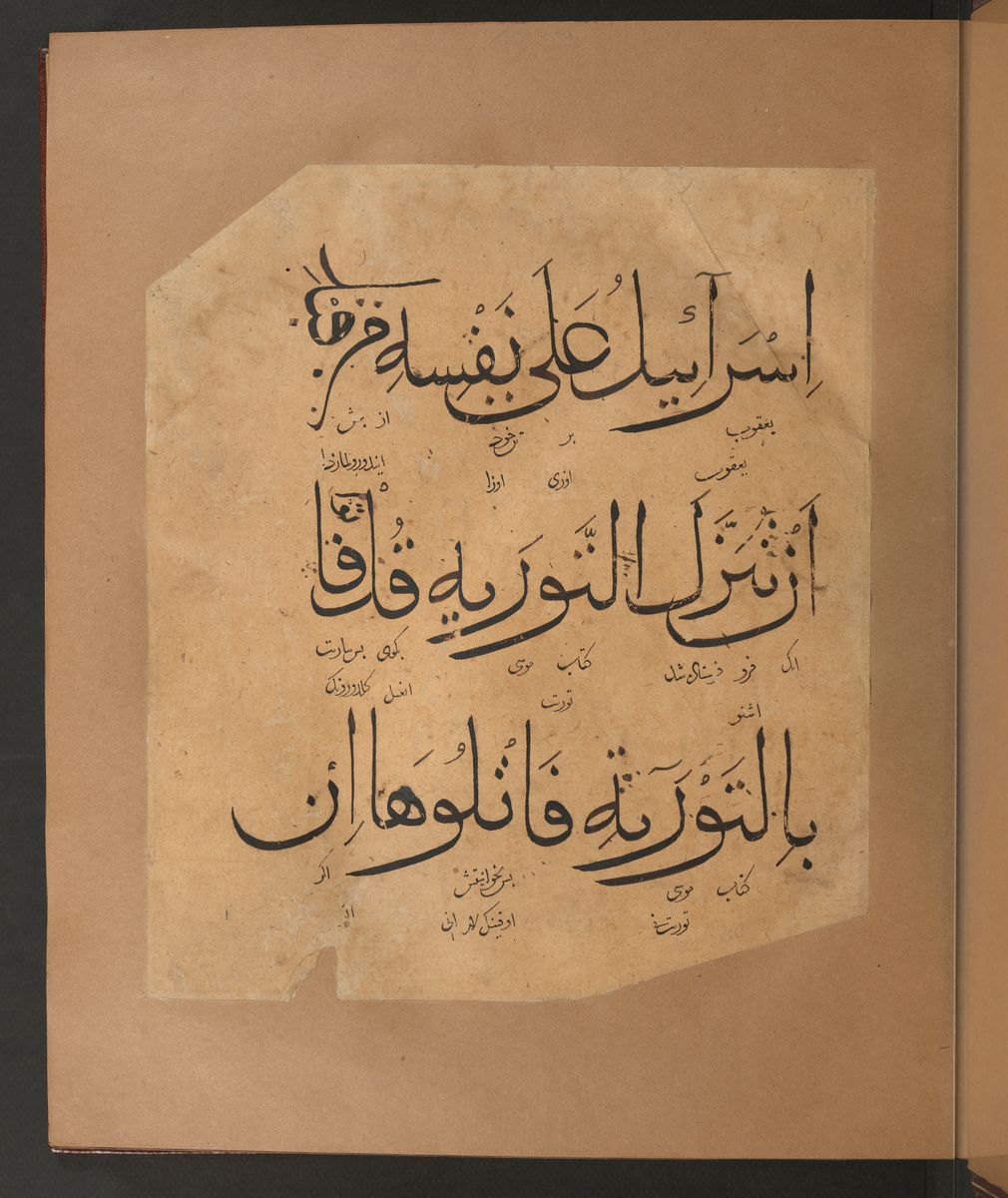
One surviving page arrangement shows how access and retention can work together. Princeton’s catalog describes Garrett 33Ge as a Qur’an manuscript with three Arabic lines per page, each followed by Persian and Chagatai translations. Chagatai is the catalog’s name for the other translation language; the proposed place, Transoxiana, and fifteenth-century date are both tentative.
The arrangement makes a useful point visible even without settling its origin. A reader can retain the Arabic text and place help for understanding it immediately nearby. The translated lines supplement access to the original rather than physically removing it.
Tibawi associated this interlinear practice with Hanafi requirements to accompany translation with Arabic. The catalog verifies the arrangement in this manuscript; it does not prove that the entire practice originated from one legal ruling. Establishing an origin would require comparison of dated witnesses and their settings.
Nor does the manuscript settle which wording should be used in prayer. The existence of a reading aid and the authorization of a ritual substitute remain different claims. What survives on a page should not be made to answer a question it was not shown to address.
The debate did not end with one medieval answer
The coexistence of Arabic and translated explanation helps explain why later disputes need careful labels. The International Islamic Fiqh Academy’s 2023 resolution opposes a program of replacing Arabic salat with translations. Its preface distinguishes that program from the familiar juristic debate, and its second ruling expressly excepts a very new convert or someone wholly incapable of learning Arabic. Its appeal to consensus is the academy’s claim, not a reason to erase the earlier positions documented here.
The 1961 Dar al-Ifta ruling and the 2025 Darulifta Ahlesunnat ruling also show different selections from the Hanafi tradition. They should be read with their dates, scopes and conditions. The present availability of an old fatwa on a website does not automatically make it a universal current ruling.
The modern disputes also had political and doctrinal settings. In his study of Egypt and Indonesia, historian Moch Nur Ichwan describes the 1920s Turkish translation project and Egyptian opposition to distributing Muhammad Ali’s English translation and commentary in 1925. The latter controversy involved its author’s Ahmadi affiliation as well as translation itself. This researched example helps explain why opposition to a particular edition cannot automatically be treated as opposition to every explanation in another language. It does not verify every confiscation or motive reported in Tibawi’s broader historical aside.
Tibawi’s suggestion that later centuries added nothing substantive cannot be established by an essay focused mainly on early authorities. Whether later work adds a new argument requires examining it, rather than assuming its answer from its date.
The investigation has therefore given us two questions to carry into any particular case: what does this rendering help a reader understand, and what authority is being claimed for its use? Defending Arabic recitation, permitting translated teaching, criticizing a poor rendering and valuing a good one can be consistent answers to different questions. We can now apply that distinction to biblical reading without pretending the two traditions have identical accounts of scripture.
Dar al-Ifta, Translating the Quran during prayer, 25 April 1961 · Darulifta Ahlesunnat, Did Imam Abu Hanifa Allow Prayer in the Persian Language?, 29 October 2025 · Moch Nur Ichwan, translation controversy in Egypt and Indonesia
The translated words make a claim about Jesus
The Bible provides a concrete comparison because cross-language communication belongs within its own texts. Its language history differs from the Qur’an’s: much of the Old Testament is Hebrew, some passages are Aramaic, and the New Testament books are Greek. Wider Christian canons should not be described as though every book began in Hebrew. The question is not whether these histories are identical, but whether changing languages necessarily prevents access to what a text says.
Mark 5:35–43 supplies a particularly clear case. In the account of Jairus’s daughter, verse 41 preserves Talitha koum. Mark explains it as Jesus telling the little girl to get up; the narrative then reports that she rose and walked. The explanation is present in the Greek text, not merely added by an English translator. Readers can follow what the account reports without knowing Aramaic, while the retained expression remains distinct from its explanation.
The content of the account matters as much as its method of communication. In verse 36 Jesus calls Jairus to faith after the report of his daughter’s death; in verses 41–42 his command is followed by her standing and walking. Mark presents Jesus as someone to trust in the face of death. This is a claim carried by the narrative, not an event independently authenticated merely by quoting it.
A serious Muslim reply must be heard here. Qur’an 5:110 likewise attributes bringing the dead to life to Jesus, by God’s permission. A miracle of this kind alone therefore does not distinguish a divine Son from a prophet empowered by God. Accepting that objection prevents a false Christian shortcut while leaving the question of Jesus’ identity open for further evidence.
This supports a modest, positive conclusion: explanation across languages belongs within the Gospel’s own way of communicating its account. An English or Russian reader is not disqualified from examining that account merely because the reader depends on translation. Accuracy remains assessable, and a difficult expression can still send us back to the source language.
The example does not independently prove that the reported miracle occurred or that Mark is inspired. Those questions require additional historical and theological reasoning. But refusing even to examine the account because it reaches us through another language would reject a means of communication the narrative itself uses.
This comparison also clarifies a common confusion about corruption. A mistranslation is a claim about the relationship between a rendering and its source. A change in a manuscript is a claim about a textual witness. One may investigate both, but evidence for one should not automatically be announced as proof of the other.
Hebrews 1:1–3 supplies a specifically Christian account of that identity. It presents God as speaking through the Son, through whom he made the world, and describes the Son as revealing God’s glory and being while accomplishing purification from sins. Its reason for attending to Jesus is his relation to God and his work. This is the text’s theological testimony; its presence on a page does not, by itself, prove that testimony true.
The comparison with Islam is concrete. Qur’an 4:171 calls Jesus God’s messenger and rejects divine sonship. In the checked Ibn Kathir commentary, Jesus is a created servant brought into existence by God’s command. That account and Hebrews’ account of the Son’s role in creation differ substantively, not merely in the language used to express them. A Muslim may judge the Christian account mistaken and the Qur’an corrective. Yet calling an account a divine correction does not establish its authority; Arabic form does not supply the missing proof. Nor would chronology alone settle which account is true. The same demand applies to Christianity: Hebrews’ claim to speak about God must be examined, not exempted because it is Christian.
Translation has now done something consequential: it has made a disagreement about God and Jesus available for examination. It has not dissolved the disagreement or decided it. The Christian proposal is that God is known through the Son and his saving work. Whether that proposal deserves trust requires the historical and theological case for Jesus, but translation itself is no reason to withhold a hearing.
American Bible Society, Biblical Languages, 16 July 2010 · Qur’an 5:110 — Jesus’ miracles by divine permission · Qur’an 4:171 and Ibn Kathir — Jesus’ status
Christian traditions retain standards for translation
Christian defenses of translation also show why access need not mean indifference to accuracy. The Reformed Westminster Confession 1.8 assigns authority to the original-language texts while requiring translation for peoples who need access to scripture. Its reasoning joins two responsibilities: retain a standard against which a rendering can be judged and make the text available to readers who need another language.
Catholic teaching takes a distinct form. Dei Verbum, sections 11–12, speaks of divine inspiration through human authors and calls for attention to their modes of expression. Section 22 encourages suitable and accurate translations under the Church’s authority, particularly from original texts, while honoring the Septuagint and other ancient versions. It does not declare every translation equally authoritative or equally careful.
The Greek Orthodox Archdiocese of America and Hellenic Bible Society’s Septuagint project describes the Greek Old Testament’s place in Orthodox worship and devotion. Its use shows that a translated textual tradition can have a significant religious role. It does not establish that every Greek reading is identical to every Hebrew witness.
These examples represent named Christian traditions rather than one invented universal Christian voice. Their models of inspiration, original-language authority and liturgical use are not simply identical to the Islamic positions described above. A fair comparison asks how each tradition supports its own standards and how particular translations meet them.
The resulting choice is more substantial than choosing a preferred language. One can examine the Christian testimony that God makes himself known through the Son who brings life and purification from sin, and ask whether the reasons for trusting that testimony withstand the Islamic reply. A good translation makes its claim available; standards of accuracy keep it answerable to its sources. The claim that Arabic form or translation loss settles the issue in the Qur’an’s favor has failed to provide the needed evidence. Trust in the Christian account must rest on its positive case, not on a supposed victory produced by disagreement among Muslim jurists.
Septuagint.Bible, Greek Orthodox Archdiocese of America and Hellenic Bible Society · Mark 5:35–43, especially 5:41, NIV 2011 · Hebrews 1:1–4 — God’s speech through the Son