


Begin with Jesus
Start with a disagreement that evidence can help us examine: did Jesus die, and why did his followers proclaim that he rose again? The historical evidence considered here favors the Christian account of Jesus’ death over the usual Islamic denial of his crucifixion. That gives a reason to move toward Christianity and examine its central claim about the resurrection.
You do not need to assume the Bible is inspired before reading its documents as historical sources. Ask when they were written, what access the writers had to the events, and whether their reports are credible. The same questions apply to claims that the Qur’an corrects them.
For I delivered to you first of all that which I also received: that Christ died for our sins according to the Scriptures, that he was buried, that he was raised on the third day according to the Scriptures, and that he appeared to Cephas, then to the twelve.
But they neither killed nor crucified him
Qur’an 4:157–158Mustafa Khattab, The Clear Quran
The message goes back to the beginning
In 1 Corinthians 15:3–8, Paul passes on a message he had received: Jesus died for sins, was buried, was raised, and appeared to people including Peter and James. The letter was written in the mid-50s AD, within the first Christian generation. In Galatians 1:18–19 Paul also reports staying with Peter for fifteen days and meeting James, Jesus’ brother.
These are concrete links to the original movement. They do not preserve every conversation, but they defeat the explanation that the death and resurrection message was invented only centuries later. Galatians 2:9 also reports the Jerusalem leaders’ recognition of Paul’s mission. Paul explicitly preaches Christ crucified in 1 Corinthians 1:23. In Galatians 1:13–24 he describes his own change from persecuting the church to proclaiming Jesus. His testimony gives us a participant whose claims can be examined.
The Roman writer Tacitus later reports Jesus’ execution under Pontius Pilate. He wrote in the early second century, was not an eyewitness and does not name his informant. His account supports the death claim outside Christian preaching. Jesus’ death has a stronger historical basis than an unsupported assertion that the early account was wrong.
about the year 56.
but we preach Christ crucified
1 Corinthians 1:23, World English BibleWorld English Bible (public domain)
Then after three years I went up to Jerusalem to visit Peter, and stayed with him fifteen days.
Galatians 1:11–20, World English BibleWorld English Bible (public domain)
gave to Barnabas and me the right hand of fellowship
Galatians 2:1–10, World English BibleWorld English Bible (public domain)
Christus had been executed during Tiberius’ reign through the procurator Pontius Pilate.
Tacitus, Annals 15.44: Dickinson College commentaryEditorial translation from Tacitus’s Latin
What would justify rejecting that testimony?
Qur’an 4:157–158 denies Jesus’ opponents killed or crucified him and says God raised him to himself. Most Muslims understand this to mean Jesus escaped crucifixion; the verses themselves name no substitute. Some minority interpretations allow bodily crucifixion. Our comparison concerns the common denial.
A Muslim may answer that God can correct mistaken human witnesses. That is possible if the Qur’an really is God’s revelation. But its divine authority is the very question under examination. The correction needs supporting evidence; calling it a revelation cannot be its entire proof. Arguments from prophecy or Muhammad’s mission must therefore be tested, rather than used as assumptions that automatically cancel the earlier evidence.
This standard also applies to Paul’s claim to revelation. We examine his early testimony and named contacts instead of treating his claim as self-proving. On the evidence considered here, the Christian account of Jesus’ death is the better-supported account.
A substitution account can say the early witnesses sincerely reported what only appeared to happen. That possibility needs supporting evidence for the hidden intervention or the revelation disclosing it. An actual crucifixion explains the testimony without adding that unestablished event.

there are other plausible interpretations of the verse
Justin Parrott, Jesus: A Foundation for Dialogue (2018), pp. 39–42, 49–50
as a confirmation of previous Scriptures and a supreme authority on them.
Qur’an 5:48Mustafa Khattab, The Clear Quran
a witness, and dominant over every Scripture that preceded it.
A manuscript opens the claim to examination
The papyrus P46, usually dated around AD 200, preserves copies of Paul’s letters. The pictured leaf is not Paul’s original and is not the page containing 1 Corinthians 15. It is a real witness to the letters’ transmission. The date of this copy differs from the date when a letter was composed.
Preservation helps us recover what a source says; historical inquiry asks whether the report is true; divine authority requires reasons for accepting its message as God’s revelation. Accurate copying alone cannot prove a religion. Its value is that we can investigate the actual Christian message instead of assuming it is lost.
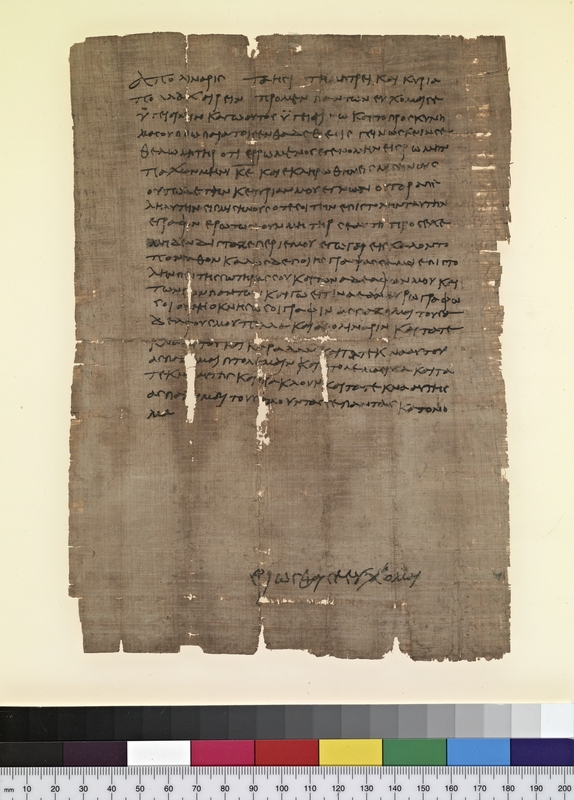
These papyri are valuable to contemporary Biblical scholars
Late second century or early third century (c. 200)
From Jesus’ death to his resurrection
The resurrection is the positive Christian explanation of the early proclamation: God raised Jesus, and people encountered him alive. It connects an actual death, early appearance proclamation, continuity with Peter and James, and Paul’s reported change from opposition to faith. Compared with a centuries-late invention or an escape from crucifixion, resurrection fits this connected testimony.
Sincere but mistaken religious experience is a serious alternative and needs examination. Sincerity alone does not prove a miracle; Paul’s report of five hundred people is not five hundred surviving testimonies. The case for Jesus’ death is stronger than the full resurrection argument developed here. Even so, the early, personally connected testimony gives a concrete reason to investigate resurrection rather than dismiss Christianity as a late distortion.
Paul states the stakes in 1 Corinthians 15:14: if Jesus was not raised, Christian preaching and faith fail. Christianity puts an event at the center of its claim. Following the evidence means examining that event, including the strongest alternatives.
What kind of God does this reveal?
The Trinity does not mean three gods are one god. Nicene Christianity distinguishes one divine nature and three persons: Father, Son and Holy Spirit. Calling that “one equals three” confuses what the doctrine says is one with what it says is three. Its truth needs an argument, but an arithmetic slogan does not refute it. A simpler-sounding account is preferable only if it explains the relevant evidence at least as well.
In 1 Corinthians 8:4–6, Paul affirms one God while including Jesus as the Lord through whom all things exist. The Christian explanation must account for both his monotheism and the role he gives Jesus. That is a reason to investigate Christ’s divine identity from the sources, rather than reject it on an arithmetic slogan.
The received message in 1 Corinthians 15:3 already describes Jesus’ death as “for our sins.” Romans 5:6–11 explains it as God’s initiative in reconciliation. John 10:17–18 presents Jesus giving his life willingly. Within the Christian account, the Son’s self-giving is God’s saving action, rather than a detached God coercing an unwilling stranger. The saving meaning of the cross belongs to the early message itself. Resurrection would be God’s vindication of Jesus and a reason to trust him; the meaning of his death comes from that message, rather than from the miracle alone.
Islam also teaches divine love and forgiveness in Qur’an 85:14 and 39:53–54. The Christian case does not depend on denying that. A Muslim can still ask why forgiveness requires the cross; a fine-payment analogy cannot settle its justice or necessity. The question is whether God has acted through Jesus as the early Christian sources proclaim, and what that action reveals about reconciliation.
one God in three persons
He has never had offspring, nor was He born.
Qur’an 112:1–4Mustafa Khattab, The Clear Quran
Allah is only One God.
Qur’an 4:171Mustafa Khattab, The Clear Quran
and one Lord, Jesus Christ, through whom are all things
1 Corinthians 8:4–6, World English BibleWorld English Bible (public domain)
other things being equal, simpler theories are better.
But God commends his own love toward us, in that while we were yet sinners, Christ died for us.
No one takes it away from me, but I lay it down by myself.
And He is the All-Forgiving, All-Loving—
Qur’an 85:12–16Mustafa Khattab, The Clear Quran
Turn to your Lord
Qur’an 39:53–54Mustafa Khattab, The Clear Quran
Follow the result
We have a reasoned starting judgment: Jesus’ death is better supported than the common Islamic denial, and resurrection proclamation belongs to the original Christian movement. This favors the Christian account at a central point of conflict and gives a positive reason to investigate its message further.
We do not need invented percentages to make that judgment. Manuscript numbers, a correct geographical detail or a religion’s popularity cannot prove all its teachings. Evidence should support the particular conclusion drawn from it; a weakness in Islam does not automatically prove every Christian doctrine. A reason to believe in a creator does not by itself identify which revelation comes from that creator.
Read 1 Corinthians 15:1–19 beside Qur’an 4:157–158, then Romans 5:6–11. Follow the connection: evidence for Jesus’ death, the explanation of his resurrection, and the promise of reconciliation. That is a path toward Christianity built on reasons a reader can examine.
used for calculating conditional probabilities